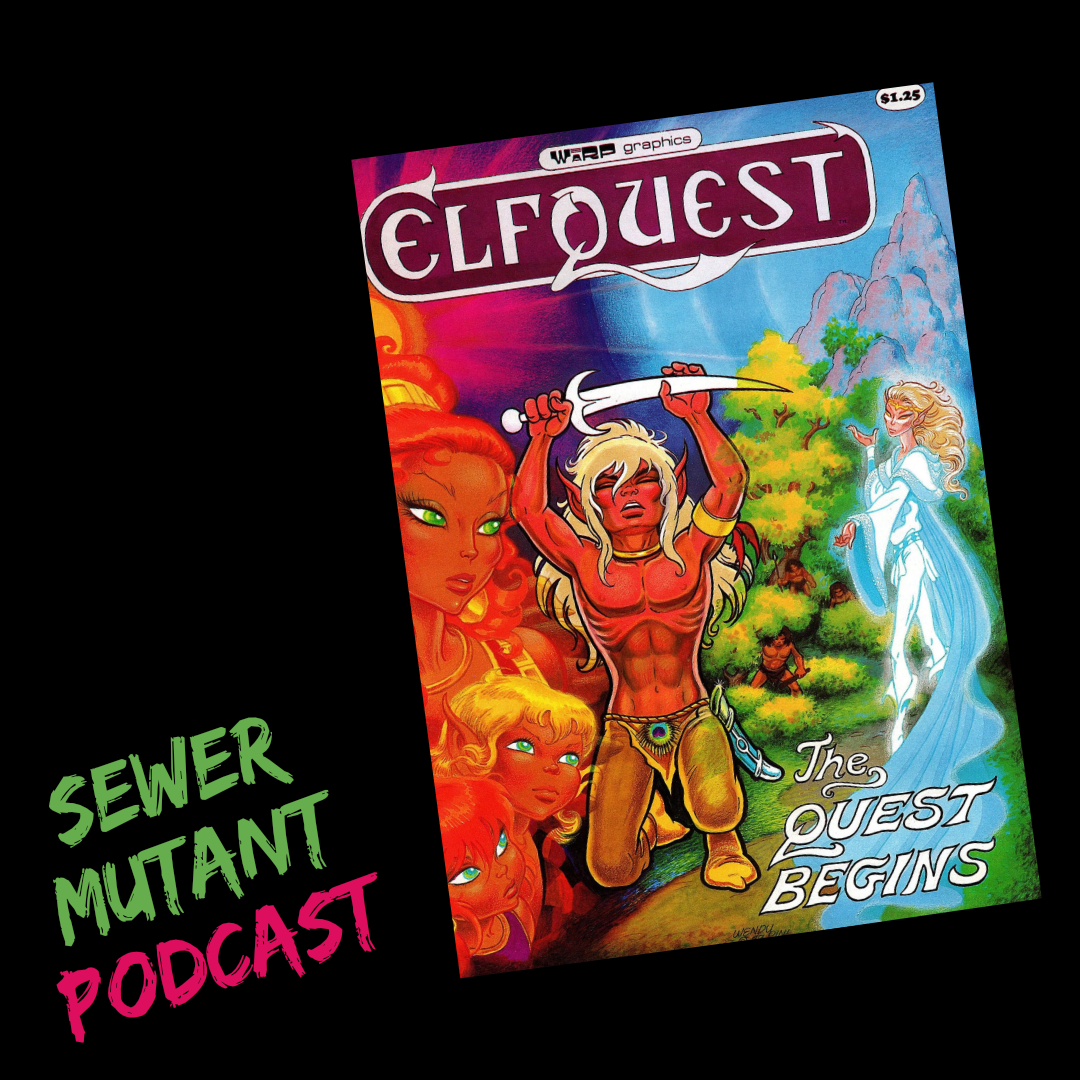
We’re joined by artist and illustrator Elinore Edge to talk about the first two volumes of ElfQuest: Fire and Flight and Forbidden Grove. We talk about the epic series’ themes of home and belonging, Wendy Pini’s incredible art and how it stood out against a sea of “house style” art from the big two, and how ElfQuest was the first comic to follow what is now the standard storytelling structure for most comics, especially independent comics. That is to say, it was a long-form story with a planned ending split up into discrete story arcs to be reprinted in perfect bound volumes. Or put another way, they appear to have invented the idea of telling a long form comics story as both single issues and TPBs. TPBs and graphic novels existed before ElfQuest, and so did story arcs. But comics were either ongoing series with no planned ending that went on until they were canceled, or they were fairly short finite series. I didn’t think of this until after we recorded, but this is also the same model that prestige television now follows: episodes form seasons and season form a larger overarching work.
Subscribe to the podcast feed or find it on Spotify, Apple Podcasts, YouTube, or your favorite podcast app.
Credits:
Hosts: Klint Finley and John Ekleberry
Guest: Elinore Edge
Music: krudler.bandcamp.com
Rush transcript:
Klint (00:13)
Welcome to Sewer Mutant, the comic book podcast for weirdos like you. I’m Klint Finley, and I’m joined as usual by my co host, John Ekleberry.
John (00:20)
How’s it going, everybody?
Klint (00:20)
Good. And today we have a special guest here to talk with us about ElfQuest. It’s my friend Eleanor Edge. Eleanor is the illustrator of the Cosmic Dancer Oracle written by Tess Whitehurst and Sedona Soulfire, and many book covers and commissions as well as several personal projects. She’s an artist, an illustrator, a dancer. Welcome to the show, Eleanor.
Elinore (00:40)
Thank you for having me. Glad to be here.
Klint (00:42)
Yeah. So like I said, we’re we’re gonna be talking about ElfQuest by Richard and Wendy Pini, but first we like to do a little icebreaker to get get us warmed up. so my icebreaker for today is what is your dream vacation spot? and it has to be outside the United States because that way John can’t break my heart by saying Seattle instead of Portland. John, why don’t you start?
John (01:01)
My dream vacation spot. man, this is like outside of the US. I don’t know. I think I’d like to go to Cornwall, England, where my grandmother’s family was from.
Klint (01:03)
Outside of the US.
Well Eleanor, do you have a a spot?
Elinore (01:13)
Pretty much gorgeous beaches in the tropics. None specifically come to mind because it could be Southeast Asia, Mexico or Fiji. I’ve never been there but I would love to go. But my favorite place is definitely the beach in the tropics. So gorgeous.
Klint (01:29)
Cool. Yeah. I mean any s you said Fiji, like a s a spot that you haven’t been that you that you want to go to. Yeah. Cool. mine is Senegal and it’s just because I saw the Anthony Bourdain episode about that. and it just looked like a really cool place. I’ve never been to Africa before except for like a tiny little bit of Egypt,
Elinore (01:34)
I’ve never been to Fiji. No.
Klint (01:50)
so I I would really like to to visit the that continent and that just seems like a really cool country. I know it’s a little cliche to pick a place based off of Anthony Bourdain, but there there we have it.
Well. So ElfQuest. Eleanor, why don’t you tell us a little bit about the the story, like what what ElfQuest is all about?
Elinore (02:07)
The
story is mostly centered around the wolf riders who are a tribe of elves that have to leave their home due to humans and are tricked by trolls and it starts a journey where they end up going and looking for others of their kind and they end up finding more than they bargained for, let’s say.
Yeah, as a overarching story theme, Elfquest is really about finding your home place and your belonging and who your tribe is, so to speak, and going on a journey to find out that maybe those that you thought were friends are actually foes and vice versa. And that
People and relationships also change. There can be relationships that start out really great that end up souring. there are themes around life, death, family, struggling with war, but also being battle hungry, and really wanting to find where you belong.
Klint (03:07)
Yeah, so there’s been a lot of different editions and publications over the years. John, do you wanna give us a rundown on which versions we read and some of the and what versions are out there?
John (03:19)
So there’s been a lot of reprints and a lot of recolorings, which is something that we talk about here a lot. But the the very first issue of ElfQuest was published by Independent Publishers Syndicate out of Lansing, Michigan. So I always have to get that Michigan connection in there. the the creators weren’t super happy with the the quality of that publication, so they decided to found their own comic book company to to continue publishing after that.
So warp graphics became a thing. I knew about warp from other comics in my collection, but I didn’t realize until we did this that it was founded specifically to publish ElfQuest, and also that Warp itself stands for Wendy and Richard Pini. So the two creators. So that’s pretty interesting. it’s also been published by like all of the majors. Marvel published
ElfQuest, after the initial run. the initial run was from nineteen seventy-eight to nineteen eighty five. And then later in eighty five, Marvel picked it up for their epic imprint and they reprinted all of those stories and gave it a wider audience that got it onto newsstands and got got, you know, more eyes on it. And then after that it went back to warp again, for quite a long time and they published a bunch of spin offs and a bunch of
continuations and then DC had it for a while and Dark Horse had it. so it’s it’s been published by everybody.
also an interesting j just a pr a print thing.
That I I thought was interesting was that when Marvel reprinted them for the epic line, Marvel was printing 22-page comic books, but the original issues of Elfquest were 32-page comic books. So they had to like reorder, you know, and break the story in different places. And Wendy actually had to draw new pages to make everything like work correctly. And so in the backs of these collected editions, they have kind of those bridging pages.
that you can see and I I had a good time looking at like the extra art that they came up with and the extra dialogue to to bridge it because the the original warp graphics series is twenty issues. That’s the original quest. there’s a twenty first issue but it’s like it’s background stuff. It’s not it’s not a story issue. And when Marvel reprinted those twenty issues, those became thirty two issues because they stretched that material out.
And and I guess it’s worth mentioning, since we haven’t already, that most of this is available to read for free on their website. I thought it would be cool if we all read the same editions. So I bought the the father tree.
editions which was their their name for their graphic album wing of warped. But the ones on the website are the DC versions, the DC archive editions. And I guess Wendy prefers the colors in those ones the best. The it’s been colored a bunch of times. But anyway, I love all that comparison of all the different stuff.
and if you want to go in the other direction, Dark Horse has put out a phone book size edition that’s just the black and white line art. And that’s pretty great. I picked it up for twenty dollars. I think the cover price is thirty, but that’s a cool thing to have too, and so I’m kind of interested to look through that and compare that to the other editions.
there’s over 250 ElfQuest issues, which is pretty crazy. and that first issue came out in February twenty eighth of nineteen seventy eight and in twenty eighteen, forty years to the day, the last issue of the final quest came out from Dark Horse.
so that’s a pretty like huge creative legacy for this for this couple to have to have made. The arts I really like the art in these first ten issues that we that we read. And you know, she ended up drawing a lot of the later stuff. There are other artists that worked on some of the spin-offs, but I believe that she did all of the kind of the core issues. But we’ll we’ll see that as we go along. And then of course that things never really end because after the final quest they came back and did another
four issue miniseries anyway, ’cause they wanted to do more. So the last issue came out in twenty twenty. I don’t know if there’ll be more after that, but it’s quite a legacy for an independent comic.
Klint (07:05)
sure yeah and that’s something I wanted to touch on a little bit is is that the the independent side of that this was it you know they started in 1978 so there was a tradition of underground comics that preceded this but this was kind of the beginning of the of the boom of independent comics that has continued on to this day they were just a little bit as self-publishers just a little bit behind cerebus by Dave Sim in
in publishing. But so they were they were part of that initial wave there. coming into comic book stores, the and that’s what really enabled them to to to build a business here is that comic book specialty shops had started to become a thing. We touched on this in the death of Captain Marvel, how the rise of the direct market created new opportunities for doing comics outside of the newsstand, though, you know, they did eventually, like you said, get onto newsstands through Marvel.
Then one really key thing is that they started publishing collections, the trade paper backs, really early on.
they published the first their first collection through Donning slash Star Blaze in January of 1981. That’s the same month as the first Cerebus trade paper back, but that wasn’t the first of the Cerebus phone books that would become famous later. Those those came further down the line.
the idea of publishing a story arc as a book and selling it, they were pretty much the first to be doing that. They weren’t the they weren’t the first to ever publish trade paperbacks or or collections or graphic novels. But what they started what they did was was really different in that they set out from the beginning to tell a story. So it’d been story arcs before and there’d been finite
stories before, but even miniseries weren’t really a thing yet. But to do a long form finite story like that at from that was intended from the beginning to be that. Cerebus wasn’t intended to be finite from the beginning. That was that was c a a completely new concept. Like they said pretty early on, We’re going to publish a collection every year with five or six issues of of and it’s gonna be broken up into these story arcs and into these
individual books. And now that’s the standard for especially for for creator-owned comics. Sandman’s That Way, In The Invisibles, Preacher, Saga, Gideon Falls, Walking Dead, like all these things that that are now like the standard black and white or creator-owned comics. That’s the that’s the format that they that they use. and that this is really where that started. I hadn’t realized that before I started putting together
notes for this and a timeline and seeing that this was the the date that they started doing this. So in a way, this is like the beginning of modern comics storytelling right here in ElfQuest.
Elinore (09:37)
I feel like I kind of need to start by sharing why I even care about Elfquest. I’m not actually a huge comic nerd, quote unquote. but then when I go and I look at my collection of illustrated books, I do have actually quite a few comics when I recollect my time when I was like twelve, thirteen, I was definitely hanging out at comic book stores.
role playing game stores. I was really into Dungeons and Dragons. I also grew up in Santa Cruz, California, which is a major redwood tree capital of the world. I grew up as a only child in the woods in Aptos, which is a small town that is just f filled with forest and creeks and all sorts of things. And I think that’s really where my love of Elfquest stemmed from.
it was a environment that I understood. It was an environment that I could relate to. I think I’m also a huge fan of fairy tales, Disney animation and the art style with like the the character proportions with the big eyes, big heads. That means that you can actually see the emotes the emotion of the characters like a lot more than I think
say like marble house style for example, and I think that creates
like a easier connection with the characters and you can see their emotions.
Klint (11:03)
do you want to talk a little bit more about the art?
Elinore (11:05)
Yeah, so ElfQuest was introduced to me from a dear friend of mine when I was in junior high. I was also part of a D&D group and so fantasy fairy tales, that was kind of my favorite stuff in life. And when I got my hands on those books, I distinctly remember reading them and
And like when I got to the end, I needed the next one. I think about some of the incredible mini series style of T V shows that we watch these days. all the HBO specials reminds me of like early Game of Thrones. That’s it’s there’s a lot of like action. It feels very like you’re watching like an animated movie. I ended up
doing a lot of copying when I was younger. not tracing, but I would basically kinda learned a lot about drawing by looking at the pictures and drawing them. I created some of my own elves. I have old sketchbooks that are filled with like this drawing style. And so I really actually feel like my style now has been
highly affected by by Wendy Peeney and the Elfquest style. I remember in when I was younger going to a college class on d drawing comics and the teacher very much had like the Marvel style and I was not interested. Like I will never forget the way that the women’s feet were drawn. They were always in that Barbie heel.
And I wanted to be able to draw, you know, action and not a Barbie heel and like not those proportions. I like the ElfQuest proportions. Again, like I was saying, I I loved animation. I loved Russian animation, anime. to this day I feel like the the Elfquest style is
More reminiscent my gosh, I can’t th think of the the name right now, but they No, I was thinking of the wizards and
Klint (13:05)
Maybe Miyazaki.
John (13:11)
Ralph Bakshi.
Elinore (13:11)
Thank you, Bakshi. Like totally. So I felt like the Bakshi like art style is probably closer and I’m always looking for that. That’s one of my favorite animation kind of styles. And you don’t see that, especially these days with so much CG. but I just really love that style. And then later when I did mentorships with for concept art
And like everybody tells you big eyes, big heads, because that’s how you connect with your audience with animation. So really influenced by
Klint (13:44)
Yeah, I liked what you
said about the emotive element of of her work. And th that was something I hadn’t really thought about. But again, putting it into the context of seventy-eight, early eighties, so much comics back then especially it was like the characters have two emotions, angry and not angry. And that’s like that’s it. that was something you know, in the we’ve John and I have talked about it.
Elinore (14:02)
Mm-hmm.
Klint (14:07)
an essay that Alan Moore wrote about mostly about Frank Miller, but also just kind of about the the history and some of the most important in influential comics up to that point of the early eighties. And that was something that he pointed out was the lack of emotion in character faces, the last the lack of expressiveness in the faces that all the faces tended to look the same back then.
Elinore (14:26)
Yeah, like even now that I’m rereading in book four and thinking how is she still coming up with dis different distinct faces? Like like every like all the quote unquote background characters, the extras, like all have completely distinct faces, body types. That was something that I like. I was really into when I was being influenced by the style. I feel also, I don’t know
as a woman, I appreciate that masculine and feminine roles go back and forth with the characters in Elfquest. I remember like I had a crush on Cutter, but I also wanted to be Cutter. You know, like like Lita was a badass, but she was also very feminine and and sexy. I like that there are all of these
themes around like family and like there’s like sex scenes and stuff, but it’s not grotesque. It’s very, it’s very just like, I don’t know, natural. And so I really appreciate that. And then like the different dynamics of their relationships with the humans. There’s like a lot of relationship dynamics that I appreciate. It’s you know, the characters are it’s a really character driven story.
Klint (15:38)
I guess the only the other thing on the art and I I really like it now, but it part of why it took me so long to read so I got the these these same editions, the Father Tree editions, at a garage sale, like the summer after my junior year high of high school, and I never got around to reading them. And then a friend came over, this was like a couple years after I graduated college. A friend saw them on my bookshelf and was like
my god, Elf Quest. And I was like, you can have them. I’ve I still have never read them. He moved to the other side of the country, so you know, I had to borrow Eleanor’s. I’m gonna buy, I’m gonna buy some edition. I haven’t I just haven’t decided which edition. Maybe I’ll end up with like way too many Elf Quest comics. But you know, the art style didn’t, you know, it just it didn’t speak to me, I guess. and I think that’s fine. not everything has to be for me. I’m kind of the demographic that everyone makes things for, so it’s okay.
but I think that’s like that’s part of what is like appealing to a lot of people is how different it is to everything else. I kinda like things to be kind of dark, I guess. And it looks it has such a cute look to it. I know that’s something that they’ve been fighting a long time. They the the guy who made Poison Elves, Drew Hayes, kind of sp specifically advertised Poison Elves as like
No cute elves and like positioned it explicitly as the antithesis of elf quest. And he had later ended up becoming good friends with the pennies and with Barry Blair, who worked there as well. But kind of as a counter to an a wizard article that that had quoted Hayes about like the cute elves, the pennies bought a ad in Comic Spire’s Guide that was like, these elves aren’t cute, or something like that. And
I guess that’s that was kind of a sore point for them. But I mean it it is a way darker and more mature comic than to me it looked like. I mean Cutter kills a human like within like the first couple pages and you know the humans burn that the forest where the elves live and force them out of their homes. It’s like very traumatic.
it’s also not a kids comic. You know, it’s it it it definitely deals with some mature subject matter. And my understanding is like it it goes more and more later on into more mature territory. But so if any if I don’t know, if you’re like me and you you’ve kind of like bounced off this because the art makes it look like it is I don’t know, you know, like a a Disney kids comic or something.
You should still pick this up. It’s it’s really good.
Elinore (17:51)
It’s it’s interesting. I don’t think of it the the style as cute at all. But I also really like like adult full length animation. What w and I recognize that that is for a very like slim audience. It’s but I that’s also I like illustrated books that aren’t necessarily aimed at kids. but, you know, like YA would
count, you know, technically Hunger Games is YA there’s tons of death and violence and sexuality and in in those stories. They’re just maybe quote unquote like simplified ways of looking at dealing with the hero’s journey and the you know n issues that we all kind of deal with.
Klint (18:19)
Yeah. Yeah.
John (18:35)
in the intro to the the first collected edition, they talk about Joseph Campbell and telling mythological stories and in between the first and second issues of Elk Quest, Star Wars came out. So like this is like a really fertile period of you know, telling these kinds of stories and kind of trying to weave these into the culture.
Klint (18:53)
I wanted to circle back to too is like the characters and and how I mean they’re just cool, you know? like the the wolf writers, they’re just again kind of goes to my the expectation versus reality of like there’s they’re badass. Like they’re just they’re just such cool characters. Like you want to be a wolf writer when you read the when you read this.
Elinore (19:10)
Yeah.
Klint (19:12)
It’s a it’s a good use of comics as a medium in a lot of ways where about like when they get to sorrow’s end in the first volume and it’s yeah everything is aesthetically very different from anything the elves had seen before and trying to do that
in prose would have been really difficult to describe all the different buildings and the and the styles of everything without kind of like completely breaking character and saying, well, this looks like Mesoamerican stuff. Like you could use that shorthand and then you would get it. But like you you don’t want to do that in prose. But then you’re trying to like describe in detail what that means in prose would be I think would be very, very difficult. So d doing it visually was really cool, but they also
Having being able to have captions and little ex explanations of things, it in a way that you wouldn’t really be able be able to do in animation or in a film, I think helps like build the richness of the world. So it’s like it’s something that’s just perfect for comics.
Elinore (20:02)
I’m still I’m still hoping that an ElfQuest movie will be made someday. I Right. It because the story itself and then it it just is such a movie. And then the characters are so rich as and especially these days, like they can do anything. But it would be great, like, you know, as many practical effects as possible, please. but I was also thinking about
Klint (20:07)
I can’t believe it. Yeah.
Or animation.
I mean, it seems like it should have been I I can’t believe it hasn’t been an animated movie yet. And I I can only think that’s like the pennies are just being very particular about who they work with on that. Like they don’t want to just sell the rights to anyone. Because I I can’t imagine that people aren’t banging that on their door for those rights.
Elinore (20:43)
I th I think of the Lord of the Rings series and how that came out and I’m like, they could totally do Elf Quest. Are you kidding me? This is this is amazing. I would love to see that. And I was just thinking about how like that the original story was like set from beginning to end and how well the story is written as like it starts out in such a small chunk of the world and
Klint (20:50)
Mm-hmm.
Elinore (21:09)
as the story goes on, it just gets bigger and bigger and bigger. So i we it’s like we actually experience the story, like if no spoilers, right? But we actually experience the story the way that Cutter does, where the the whole world that we think first starts is just the wolf rider, right? Just trees and the halt and sending and this this is it. And then it’s just and then just sorrow’s end.
So those but then as they continue you start thinking about like, well, where does the story end? Or and it doesn’t seem like it does. So the world building isn’t thrown to you right away. You get the the world gets to open up as you continue to like journey with them. And I love that. Like by the time they’re getting to towards the end of
Klint (21:56)
Yeah, that’s a great
Elinore (22:00)
you know, reaching the castle towards the end of book four. it’s just a such a different story than like the first two comics.
Klint (22:08)
Yeah, John yeah, John
and I have only still read the first two volumes, but even by the end of the second volume, like the amount that has been that the that the scope has been expanded is is really interesting.
like you said, like the the relationships with humans gets severely complicated in the second volume, where in the first one they’re like it just seems unambiguously like the humans are bad, like they’re just bigoted, mean people. and there’s a little bit of a hint, you know, in that that flashback about how Cutter’s father died, about maybe it’s not so not as simple as that.
But then you yeah, you start to get more of the human’s perspective in volume two.
Elinore (22:45)
And I feel like that opening of the world, it allows space for the reader, space for the audience, because then you can’t help but think outside of what you’re reading, because the world is so immense, you’re like, my gosh, what other kind of tribes could there be and that we don’t know about? And we don’t even necessarily have to read about it. We get to be part of that story because there is that
possibility of imagination and imagining like all sorts of different tribes of elves and worlds
John (23:18)
of another interesting parallel with Grendel, I feel like, where you’ve got, you know, one creator telling the story, but then other creators get to kinda come in and do their take when they did the Grendel tales and all that. So I’m flipping through the black and white edition and the the art is just so lush. And I think part of it’s just that it’s great art, but also it’s like when we were looking at reprints of Warrior that were squeezed down into a smaller edition. It makes it feel like it has a lot of detail because you’re looking at a magazine sized page.
compressed into a into a smaller page. the the design of Cutter in particular reminds me of a a cartoon that I watched as a kid, Pirates of Darkwater. Like he looks like the main character from that. And I I don’t know if there’s any kind of influence there or anything. But yeah, I’m I’m really enjoying this. It’s it’s good stuff.
Klint (24:03)
Pirates of Darkwater is a name I haven’t heard in a long, long time. I don’t know that I ever watched that, but I do remember the name. Wow. It’s a that’s a throwback.
Yeah, you you mentioned like the the epic issues. So I’ve been trying to look I’ve been looking at what I was reading at I was reading the father tree in print and then I was like referencing s also the black and white version on that’s on global comics and the the color versions are on their website and they’re also available through the library system Hoopla. So I was looking at at those and then at scans of the Star Place editions and
spotting some differences. or there’s there’s a page where it’s a little bit of a flashback about a little bit of Skywise’s background and why he hates humans so much that that’s in that’s not in the black and white versions or in the Star Blaze versions. I think that’s introduced in Epic and then it just becomes one of the regular pages from there on out. It’s not in it’s not in the back.
with the other epic pages. It it actually just became like a main page in the story. And then one of the pages in the issue where they are captured by the trolls, one of those a couple of those pages are actually redrawn and with some of the dialogue redone. it just makes it a little bit more clear. It’s like censored or anything.
John (25:18)
Well, and the idea that she’s doing everything too, like she’s kind of a one woman army, like you know, she’s doing the pencils and the inks, So that you know, that just kind of reminds me of, you know, other other independent creators like Obar or, you know, whomever who’s do who’s doing the whole thing. You know, they’re
Klint (25:31)
Yeah.
And she did the color
in most editions, not in the Father Tree editions, but most of the other editions she did the color. Richard letters it, I think. but I think Wendy actually scripts it too.
They so they they write it together is the way she describes it, but I think the the actual scripting is is done by her as well. So it and the original idea came from her. Like it it is primarily her vision. I I don’t wanna knock Richard or anything, but it’s like it’s pretty clear like this is this is her vision primarily.
Elinore (26:02)
It is crazy to me rereading this as an adult now who’s also like a professional illustrator and really getting the weight of how much art and how good it is. Like the compositions are so good just of the individual frames, but then there are also so many pages that are just laid out like so smart and beautiful and just the
way that the the different transitions are. Like they’re just there are so many creative compositions, that’s not good for radio, but you know, just looking through some of these pages and that the way that they’re laid out and I just don’t see that very often.
Klint (26:45)
What yeah, one of the things that impressed me was like how fully formed she is as an artist right out the gate. this is like her first like the first issue. even looking at the black and white version, it’s like it’s so solid, so mature. I guess she had done some stuff in fanzines before, but there’s there’s only a handful of artists that I can think of that really have that th who just come out the gate that strong. Jaime Hernandez is one of the
one of the others of of Love and Rockets fame where it just like the first issue of that, it’s like, how is this these guys his first comic book? Like it’s and but and Elf Quest is that way too of just like what like like how did you how did you do this?
Elinore (27:22)
They the and the style is so complete o off the gate. And she’s like characters, no problem, environments, no problem. And they’re also like they have such a specific character already.
and and like the costume design too, even. Like the costume di like everything is so designed and it it blows me away the combination of the world building plus just the skill of the drawing.
Klint (27:46)
Yeah.
Yeah, it’s it’s cool,
like each of the different like elf cultures is like has is so visually distinct as a as a culture, the same way different human cultures are that and that’s the sort of thing I you know, I I think a lesser creator would have just assumed like, okay, even though they all got separated at some point in the past, they would all still just have the same aesthetics, you know, they would all have the same
ideas and I don’t know, like they would they would all just be the same, even though they’re all scattered out or or or whatever. But she had she and Richard had the good sense to think like, no, that’s I mean, humans all came from the same place originally. And look how varied we are. Even within the same city, like there can be a dozen accents. And you know, why would why wouldn’t it be the same case with the elves?
Elinore (28:34)
Exactly.
And who doesn’t love characters with with animal companions?
Klint (28:38)
Yeah, like I said, the the wolf riders are I I think all three of us on this call are are cat people, but I I I love the the relationship between the the the elves and the wolves and yeah the the whole their whole thing, I guess.
Elinore (28:51)
It’s funny as an aside, so when I was younger and I was and I was drawing from the book and inspired from the book and everything, I created a tribe of elves and they were cat riders and they lived in the desert. So that was the like the tribal like the the desert elves and they and they rode on lynx cats.
Klint (29:12)
Links are a good choice for a yeah, like a cool visually distinct cat,
John you have anything else you wanted to get into on this.
John (29:19)
No, I think we covered I think we covered it all. But I mean I’m I’m happy to see the world expand and get into more issues of this. the first ten issues there is some unfolding of the world and the mythology, but also it’s just kind of the story about a boy that’s obsessed with a girl. And I’m sure that we go we go further than that, you know, as we as we go further into the issues.
Elinore (29:39)
it gets so good. I’m just excited for you guys to like read the next books. Like it’s like we’re just getting started. I feel like book three is is maybe my favorite book. Book four is like one long battle.
Klint (29:53)
Yeah, well we’ll have to do another episode for the other the next two books from the core original quest. who’s everyone’s favorite elf so far?
Elinore (29:53)
It’s fun.
John (30:01)
I gotta go Cutter for sure. He’s the most developed, but I mean I like a lot of the other ones too. And and I do think it’s a good observation that they’re all like visually distinct. Like it’s it is it is interesting to look through here and you know, like even just looking at the covers and stuff, like it they’re they’re all very different character designs. but yeah, I like cutter the best.
Elinore (30:20)
I mean same. I’ve been a cutter girl since the beginning. Like I said. Had to totally had a crush on cutter, but also wanted to be cutter, you know.
Klint (30:29)
Yeah, I thought we might have some votes for Skywise, but I I I would have to go with Cutter too with a I’m I’m forgetting her name, his daughter as a a close second. And even though we ha we don’t get to see that much of her in the second volume. Ember, yeah. Yeah. And I know that she becomes bigger later on because I’ve seen some of the covers of of some of the the future books
Elinore (30:41)
Ember? Yeah.
It’s fun to to see the the the little kids grow up. Like that she actually does such a good job of creating characters that shift as they get older, both visually and then their character stories as well. I’d I’d say I also I have a weird like self place in my heart for nightfall.
I really like her design. I like the struggles that she goes through. I feel like she’s a very strong female character, while also like like
She doesn’t have to be masculine to be strong. I really like her and I like the story of Red Lance and I l I like what ends up happening too with their with their story in the long run.
Klint (31:29)
Well look I I look
forward to finding out about that. Yeah, the gender stuff is really interesting because the there are especially at the when they go to the to Sorrow’s End, there’s like more of a a they f discover there that there are there’s more of a gender there’s more gender differences there than than there were in their in the tribe in the Holt. So that’s just like another cultural difference.
All right, well, we will be back for another Elf Quest episode as we as John and I get into the the second two volumes. we might also in between then and between now and then do finally do Ronin. Maybe we won’t, you never know. but yeah, tune in next time to see what happens.
Elinore (32:07)
Are you
John (32:24)
And then look at this new kitty. I know he’s gonna have to cut that out now.
Elinore (32:26)
So little