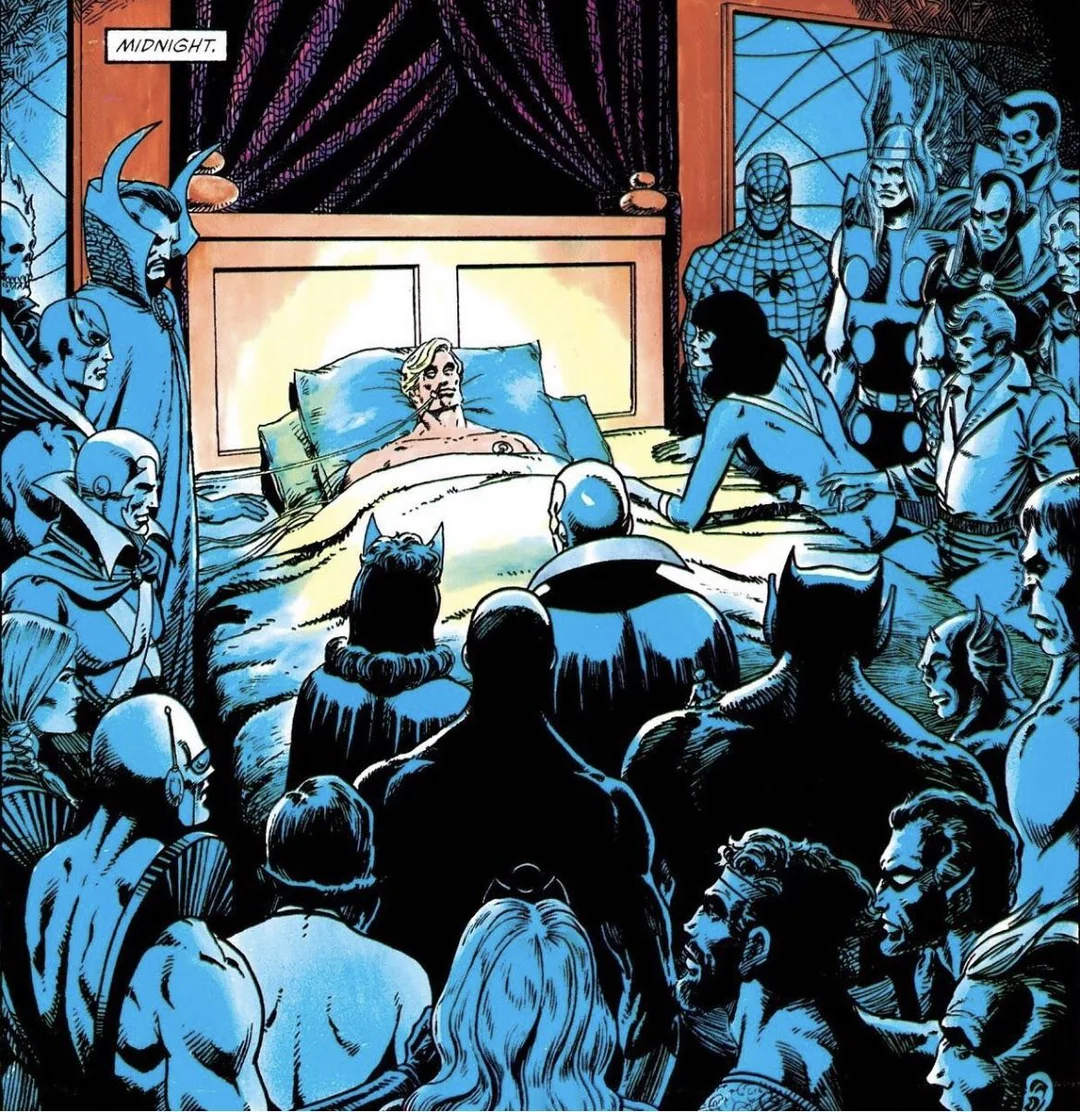
In this episode we dive into Marvel’s first graphic novel: The Death of Captain Marvel by Jim Starlin. We discuss:
– How this kicked off the character death trend during the Dark Age of Comics
– The birth of the direct market
– The roots of Cosmic Marvel
– Why Michigan punches above its weight class in the comics industry
Subscribe to the podcast feed or find it on Spotify, Apple Podcasts, YouTube, or your favorite podcast app.
Credits:
Credits:
Hosts: Klint Finley and John Ekleberry
Music: Krudler
Mentioned in this episode:
A Skrull who appeared as Mar-Vell, named Khn’nr, appeared in Civil War: The Return and a 2008 Captain Marvel mini-series.
Silver Surfer apparently visits Mar-Vell in the afterlife in Silver Surfer vol. 2 issue 63 (I guess it was later revealed that this wasn’t really Mar-Vell but part of the Surfer’s own psyche)
Mar-Vell temporarily returned to life in Chaos War: Dead Avengers, and in Secret Avengers issue 26.
Other titles in the Marvel Graphic Novel series: God Loves Man Kills, Dreadstar, New Mutants, Futurians.
It was actually Daredevil: Love and War by Miller and Sienkiewicz that I was thinking of, not Elektra Lives Again, which was graphic novel from Marvel’s Epic line, not part of the Marvel Graphic Novel series.
DC published DC Graphic Novel. Example: Dogs of War by Jack Kirby.
Transcript
Klint Finley
Welcome to Sewer Mutant, the podcast for Weirdos Like You. I’m joined by my co-host John Eckelberry, and as always, our music is by Krudler. How you doing today, John?
John
Doing great. How are you doing over there?
Klint Finley
I’m all right. Just got back from a, well, not just now, but back from a work trip to California last week that took a lot out of me. I’m excited to sit here and talk with you about comic books, specifically the death of Captain Marvel. But first, we’d to do an icebreaker to help listeners get to know us and help us get to know each other a little bit better.
So this time, John’s going to ask the icebreaker question. So what do you got for us, John?
John
Yeah, I was excited that you offered for me to do one of them. This is something I ask people in real life too. And some people have a quick answer and some people do not have a quick answer: What is your favorite film?
Klint Finley
So my go-to answer for this is usually Brick, neo-noir movie by Rian Johnson with the guy with three names, one of the actors with three names. That’s him, yes. Yeah, might not be a huge surprise after the Alack Sinner show that I’m a noir fan.
John
Joseph Gordon-Levitt.
I actually still need to watch Brick. I know of it, but I haven’t watched it. one of my friends, Ben, is a huge fan of it and is always telling me to put it on my to watch list. So I will definitely make that the next thing that I watch.
Klint Finley
And, yeah, I mean, there’s a lot of movies that I like that would be up there along with it. Mandy is one with Nicolas Cage, Hold the Dark, a horror movie that came out a few years ago on Netflix. The original Conan the Barbarian. But yeah, Videodrome by Cronenberg… Yeah, Brick is the one that I usually just kind of rises to the top there for me. How about yourself?
John
I’m pretty easy to figure out. would have to say The Crow. But if I stretched it out to a top five, we do have one in common. Conan the Barbarian would be in my top five as well. I love the soundtrack and also just love the film itself. And then I guess to round out the five, it’d probably be Taxi Driver, Gladiator, and the original Highlander, which is cheesy, but I love it. And I’ve watched it a lot of times. I think part of the way I rate
Klint Finley
Yeah, for sure.
John
you know, how much I love a movie is how many times I’ve rewatched it. And those five movies I’ve I have spun my DVDs to death. And now that we’re in the digital age, I’ve watched them some more times. So, you know, if I if I want to watch something, you know, like 10 or more times, it’s probably something that really stuck with me. There’s not a lot of modern movies that I rewatch. And the older I get, the less I rewatch. I usually just watch things once in the theater and call it a day, but there are some perennial ones that I revisit.
Klint Finley
Yeah, I’ve kind of surprisingly gotten more into modern movies in the last several years. You probably noticed there are a few more recent movies in there, like recent by old guy standards. You have a couple of those from 2018, I think, and I would throw Mad Max Fury Road onto the list towards the top.
All right. So speaking of old guy stuff, let’s talk about the Death of Captain Marvel. So this was kind of interesting to read this coming off of Marvelman slash Miracleman, because these are both the Marvel Captain Marvel and Marvelman are both kind of descendants in a way of the original Fawcett Captain Marvel, but the Marvel Comics one doesn’t have, know, it’s more separate from the original. It was just, he was just kind of created to secure the trademark on the name Captain Marvel. And so the reason I wanted to talk about this was it kind of touches on a few major topics for the Dark Age of comics. So one is the rise of the direct market. This was one of the first books that Marvel did that was specifically targeted and sold only to the direct market. Another is character deaths in comics. Obviously, the Death of Superman’s the big one, but the the death of Jason Todd, which was also Jim Starlin, and the deaths of the Barry Allen Flash and Supergirl in the crisis on infinite Earths, which kind of kicked off the Dark Age, are some other like really notable ones. And then I don’t know, basically everybody in Coast City died. It’s, yeah, death was all around in the Dark Age. And the other piece of it is kind of just that movement towards realism or like pseudo-realism in comic books. Those are all fairly big elements of the Dark Age. And this really touches on some of those.
⁓
John
Captain Marvel’s interesting because unlike many other comic characters that have been killed off and then later resurrected, they never really have brought him back. They’ve had legacy characters and they’ve had, at one point, a character impersonating him during Civil War, but they’ve never actually brought Captain Marvel back to life. And I kind of like that, and I hope they never do. I suppose at this point they won’t.
Klint Finley
Yeah, I think there’s been some instances where he came back to life like briefly and I think the Silver Surfer like visited him in the afterlife, but yeah, he has actually stayed pretty dead over the over the years So do you want to I don’t know. What did you think of this? I didn’t know how you would how it would hit when…
John
I liked it. I liked it from an art and coloring standpoint. I like some of Starlin’s other stuff. I was more familiar with Warlock than with his Captain Marvel stuff. And I did read some of the other Captain Marvel stuff along with this, which we’ll talk about in a bit here. But yeah, I enjoyed it. I enjoyed the… They tried to bring as much realism as possible to a world that’s completely bonkers and has cosmic craziness going on. But they wanted to ground it and have something like cancer be an actual threat to Captain Marvel. And they had in-story reasons why they were unable to cure that. And I know in your notes, too, you’ll talk about the idea that we have all these scientists in the Marvel universe inventing all kinds of stuff left and right, but they can’t figure out how to cure cancer.
Klint Finley
Yeah, Yeah, I ended up liking this. I had read Starlin’s original Captain Marvel run before this, and I had read his Warlock run. And then for whatever reason, I just skipped over this and went straight to Silver Surfer. I think I was just eager to get to Infinity Gauntlet, and Silver Surfer leads into that. So I had just let, know, this was, so it was kind of just going back and filling something in for me in a way. But so I guess I came into it with a little bit of context there.
So I liked it more than I think I liked… I liked it less than Warlock, but more than his initial Captain Marvel run. My main complaint is just that there’s a lot of instances here where the figure drawing looks just flat out bad, like kind of amateurish. And I don’t know. Yeah, it was just surprising and weird. Like I almost wonder if like he had an injury or something that was during this period or I don’t know what it could be. But the backgrounds look great, so I don’t know if he was just like putting all his work into drawing, like buildings and starships and stuff and just not worrying about the, the figure drawing, or if it was always… And maybe I should look, go back and look at some other stuff by him. And maybe I had just overrated his art previously, but I don’t know. Yeah, it just doesn’t. A lot of it just doesn’t look good.
The color I would also agree is great. I mean, this was a really great time for comics color. They were starting to transition over to using better paper and more expensive printing techniques that could reproduce better color in comics. So you get an upgrade over the old newsprint four color process that you know, that was familiar from the golden age and silver age. But at the same time, it’s before everyone went fully into the world of digital color that had it just, just doesn’t do it for me. So there’s some really, really nice looking stuff in this.
John
And as you mentioned, they were thinking about the direct market when they put it out. And so this was the first in the line of Marvel graphic novels. And there were a whole bunch of different Marvel graphic novels, some of them with Marvel characters, some not. The third one is actually another Jim Starlin one that introduces his other character Dreadstar. And then there’s some really important ones like God Loves Man Kills is in there someplace. There’s a bunch of…
Klint Finley
The first appearance of New Mutants is in graphic novel number four.
John
You know.
Yes, the first New Mutants is they have that before the first issue of the ongoing. And it’s in kind of a larger magazine size format. And, you know, as you mentioned on better paper.
Klint Finley
Yeah. Yeah. There’s, there’s a bunch of these. Like, I think there was like a Frank Miller and Bill Sienkiewicz Electra one that I had never even heard of, didn’t. Yeah. Yeah. Yeah. I mean, I knew about Electra Assassin, but yeah, there’s, there’s a bunch of, there’s a bunch of them and yeah, look at more of them. It’s… There’s a Futurians by
John
Yeah, Elektra lives. Yeah. We’ll talk about that eventually. That’s a good one.
Klint Finley
Dave Cockrum, who created the new X-Men. And yeah, just a lot of significant work. A lot of it was, you know, like God Loves Man Kills, there’s something that I don’t think of as like, this is part of a title that was called Marvel Graphic Novel. It ran over a number of issues or like the first Walt Simonson Starjammers and Dreadstar, all those things. it’s you know, they’re all things I knew about, but like didn’t necessarily think of, you know, realize that they were part of this ongoing title. And you pointed out to me that DC also had DC Graphic Novel. And I think the only one of those, when I looked at the list that I had heard of was Dogs of War by Jack Kirby, which was his much delayed conclusion to the Fourth World Saga and I didn’t realize that that was even the same boat is like God Loves Man Kills, this is a classic work that is just happens to be part of this graphic novel line.
So yeah, I don’t maybe to expand a little bit on the the background of the character so initially, you know, he was completely different from the ⁓ from the faucet slash Shazam Captain Marvel He was just a a Kree warrior
who his name just happened to be Mar-Vell, and so they called him Marvel, Captain Marvel. But then, in the graphic novel, in the death of Captain Marvel, it explains a lot of his history and background, so people who aren’t familiar with the character can kind of jump in and get most of the story from that. they added this twist where he’s trapped in the negative zone, but he can swap places with Rick Jones, who was…
kind of the Hulk’s sidekick. So it gives it that teen turns into a superhero vibe that the original Captain Marvel had and that Marvel Man, you know, is descended from as well. So there’s some commonality, though by the time Marvel graphic novel number one hits, I guess they’d become disentangled in that way and they’re just living their own separate lives.
So you dug in I think a little bit more into the the history and context of this book, right?
John
Yeah, after I read it, like you said, they do have a background for the character. So I do think that you can read this on its own and it plays fine. But I just kind of thought, jeez, I don’t know some of these secondary characters. I don’t really know anything else about Captain Marvel. I hadn’t read any of his series. And so I wanted to go back and read some of that stuff. So I decided for context that I’d
Well, I am a great maker of spreadsheets. This is something you should know about me. So I immediately made a spreadsheet of all of Jim Starlin’s stuff. And I thought, OK, I’m going to read all of the Captain Marvel stuff leading up to the death of. And then I can get an idea of what’s going on. And the interesting thing that ⁓ I learned is that when you do that, it’s really just reading all of Thanos’s appearances. So in Iron Man 55, which is actually a really important book,
You get the first Thanos, the first Drax the Destroyer, the first Blood Brothers, you get Mentor, Eros, Isaac, Kronos. These are all in the mythology of Starland’s Titans. He just like lays it all out in this one issue. And I kind of feel like if he’d been working on some other Marvel book that wasn’t Iron Man, he still would have tried to talk them into letting him do this. Because for one issue, it feels like there’s this giant fully formed idea that he’s like, here’s my cosmic saga.
here’s all of it and then let’s run from there. And so you get all these introductions in this one issue of Iron Man. And then he goes on to be the penciler and eventually plotter of Captain Marvel. And he decides to pick up all those ideas that he laid down in that issue of Iron Man. And so in Captain Marvel 25 through 33 and Avengers 125, there’s a story called the Thanos War.
And there’s a couple other tie-in issues to Marvel feature number 12 and Daredevil 105. I thought it was weird that Daredevil somehow got looped into this whole cosmic thing, but there is a segment in that Daredevil issue that features the origin of Moondragon, who’s another connecting character to the whole thing.
Klint Finley
Yeah, and that one’s not by Starlin though, right? It’s a Steve Gerber joint.
John
Starlin draws the segment with Moon Dragon in the middle of the book, but otherwise, and it’s kind of weird because it like shows like Thanos as a child in that, like he’s this like little grumpy, you know, adolescent Thanos. And I think I just thought it was funny. But so I read all of that. And then as a cherry on top, I read Captain Marvel 34, which is the first appearance in Nitro and then tells the story of his encounter that eventually leads to the cancer that kills him in the Death of book. Most of these things were reprinted in 1985 as a five issue reprint series called The Life of Captain Marvel. And then they did a collected edition called The Life and Death of Captain Marvel. You can still find that out there for pretty cheap. There’s also other reprint editions, various ones that have this content. I know everything’s kind of going to omnibus editions now and so they’re more interested in including everything. So, you know, you can buy omnibus that have all the way from Captain Marvel number one to whatever. But if you just want to read the Jim Starlin stuff, that’s collected together out there too. There was even one at one point called Captain Marvel by Jim Starlin that has just this stuff. Between Life and Death is when Warlock happens. And those are the rest of Thanos’s seventies appearances.
And his encounter with Warlock leads to both of them getting killed. So when Captain Marvel dies Thanos and Warlock are also dead and haven’t appeared for a little while and then they don’t come back until Infinity Gauntlet in the 90s and You had mentioned Infinity Gauntlet and that being the thing that you wanted to kind of get to and and skip past some stuff for. And I think even though people know more about the Infinity Gauntlet in popular culture, even though people know more about the Infinity Gauntlet, the Thanos war, if you read it, is really like the template for that story. It’s about Thanos getting the Cosmic Cube to obtain Godhood and to impress death, which is like the same story that’s in the Infinity Gauntlet, except for he gets the Infinity Gems instead.
Klint Finley
Yeah.
John
And so it’s almost like he’s just retelling that story on a bigger stage with more characters.
Klint Finley
They end up defeating Thanos in kind of the same way, or Thanos kind of allows himself to be defeated in the same way in those two stories. I don’t know if you’ve read Infinity War, but that also is basically a retelling or like a… It is the same to Warlock, the original Warlock series, as Infinity Gauntlet is to the original Thanos War storyline. Kind of just goes through a lot of the same setup where the same villain, the Magus, and Thanos as a good guy in it, or at least initially. Yeah, so it’s kind of interesting. It seems like he just came back to Marvel and was like, all right, I’m gonna just do the same, do these same stories only, like you said, like on a bigger scale, more characters.
John
Which seems to have worked for him because this is a giant enduring work now that people go back to and enjoy. But I think that anybody that likes those stories owes it to go back and read the original Thanos work. Cause I don’t know if a lot of people have or they know about it. I hadn’t read it. This is the first that I’d read it. And as I’m reading it, I’m just going, Hey, wait, like this is, this is the Infinity Gauntlet, but like the OG version.
John
And it’s really cool. Captain Marvel 29 has the whole origin of the Titans, which are kind of based on Greek myth. And that was a great issue for me. And a few years later, you had mentioned the Fourth World. Jack Kirby came back to Marvel. And he had been at DC for five years. And he did the Fourth World saga. And then when he returned to Marvel, he worked on Captain America and then also the Eternals. And the Eternals was supposed to be like separate. It wasn’t in the regular Marvel continuity. It was just a separate thing that he created. And he also kind of based that on Greek myth. And so it was not in any way connected to Starlan stuff. But in the late 70s and early 80s, Roy Thomas kind of saw that connection and him and also the editors, Mark Gruenwald and Ralph Macchio wrote the Eternal Saga in Thor, which kind of tries to put all this stuff together in the same continuity. So suddenly, the Eternal stuff and the Jim Starlin stuff becomes enmeshed as the same story, even though it wasn’t originally intended that way. And they also loop in the 1950s Marvel Boy character created by Stan Lee and Russ Heath. So all that cosmic stuff kind of gets tied together for Marvel’s continuity. But that’s a whole other canned of worms.
Klint Finley
Yeah, there’s also another connection there in that, like Thanos is kind of, I wouldn’t go so far as to say a ripoff, but he’s definitely influenced by Darkseid from the Fourth World. Yeah.
John
Right, exactly. everything’s kind of, yeah, everything’s kind of feeds on itself and is a little bit incestuous.
Klint Finley
And you can see, yeah, like Mentor is kind of like the Patriarch from the Fourth World and Eros is maybe a little bit like Lightray. So yeah, seems like there was, yeah, it’s interesting to see those kind of get bound up and merged later. Yeah, so outside of the actual comics in and of themselves, I mentioned like this was a big moment for the direct market.
So comic, and I’ll explain a little bit of what that actually is. For those who aren’t familiar with the term, just means comic books sold directly to comic book stores or, you know, comic book specialty shops. This is even really before our time when comic books were sold to newsstands primarily.
I mean, growing up, I never really saw newsstands. I mean, I saw the spinner racks at the grocery store and that’s how I started getting into comic books. But the idea of a newsstand as a enterprise selling magazines and newspapers and comic books is not something that I’m actually really all that familiar with from first hand experience. But that was the original way that they were sold.
The downside for publishers is that they were returnable. So if the comics didn’t sell, the newsstand sellers were supposed to rip the covers off and send them back. Or send the covers back and then get reimbursed and destroy the coverless versions of the comics. So in the 70s and early 80s, the comic book market had been struggling quite a bit over a number of years by that point. The Star Wars comic book really helped Marvel and the Superman movie, the original Christopher Reeves one, really helped DC out. But the newsstand sales were, those were decreasing. There was also a lot of allegations of fraud there where new stands would claim to not sold something and then just sell that, maybe sell them without the covers or whatever the case may be.
I think in some cases they didn’t even have to send the covers back so they could just say it didn’t sell. So, the, publishers were really looking for new ways to reach customers. Comic book specialty stores had been around for a while, but they mostly just, they weren’t buying comics directly from the publishers. Initially they were buying, they were, maybe they were buying them from newsstands and then selling them, or they were buying people’s collections and selling back issues that way. Different places worked in different ways. Then in the very late 70s, you started to see companies like Eclipse and the publishers of ElfQuest, Dave Sim with Cerebus, various creators like that, just selling their comics directly to comic book stores. And that helped them get around the Comics Code Authority so they could do whatever they wanted. They didn’t have to figure out how to get onto newsstands. And they started to see significant success enough to maintain businesses and keep afloat. So the publishers started to sell stuff directly to the comic book ⁓ shops as well.
And Jim Shooter started to notice that some comics did better in the direct market than they did on the newsstand, that their direct market sales were increasing where their newsstand sales were decreasing. So he wanted to really tap more into that market. So he came up with the idea of starting to do products that were sold only to the direct market and bypass the newsstand entirely. So the Marvel Graphic Novel series was one of those endeavors. Like I said, I think it may have been the first thing that Marvel published that was only for the direct market. Around this time, they also did reprints of Warlock, I guess also kind of capitalize on Jim Starlin coming back to Marvel after some time away. And I think those were kind of like double-sized comics that would have two issues of Warlock per issue. So not trade paperbacks, but starting to kind of tap into that idea of having perennial books kept in print and tapping into the direct market as a way to reach people. And then on the character death side, there had already been a lot of character deaths in comics before: Bucky, Gwen Stacy, Thunderbird from X-Men, Jean Grey, and then we talked about warlock dies in Warlock. One of the earliest examples I found was in the Golden Age Daredevil in like his second appearance. He seems to die, but then it turns out that it was his brother wearing the Daredevil costume. So he comes back within the same issue, but I kind of count that as, you know, in that world of like characters dying and coming back. But up to that point, the deaths hadn’t really been done as big events. Jean Grey’s death, I think, kind of was, but they were always sort of also like liabilities. They didn’t know how fans would react. But it turned out that the deaths of Gwen Stacy and Jean Grey in particular, even though it made a lot of people angry, they also juiced sales, especially the death of Jean Grey. Think that’s what catapulted X-Men into being Marvel’s number one comic, going past Spider-Man and Fantastic Four, which was, you know, now it seems obviously, of course, X-Men’s Marvel’s biggest book. But back then it was it it was not it was kind of more of a cult favorite book. And ⁓ Fantastic Four was the big team.
from Marvel. Jim Shooter knew by this time then that fans, especially collectors, liked these character death books. And he saw this direct market opportunity. So he tapped Jim Starlin and said, Hey, do you want to kill Captain Marvel? I don’t know if it was, you know, because he had done Captain Marvel before, or if he knew that Starlin could be counted on to do some unsentimental character murder because he had already done in Warlock. I guess Shooter also asked him to kill off the master of Kung Fu and Starlin, who was also co-created by Starlin, and Starlin declined to be the executioner of that particular character. That’s who Shooter was turning to for this.
John
Ha
Klint Finley
And like you said, what’s kind of crazy is that Captain Marvel stayed dead for all this time. And so the other key theme that I mentioned is the realism in comics. And that was something that actually surprised me about this book going into it, because I really didn’t know anything about it other than that Captain Marvel died in it.
I didn’t realize that he dies not from like, he doesn’t die in a battle with like Doomsday or something like that. He dies slowly of cancer over the course of the book. And that’s something, something else that I don’t really think I’ve seen anywhere else. Like having a superhero die of essentially not, it’s, I mean, he got it. He got cancer while he was doing superhero stuff, but dying of something essentially like natural causes the way anybody else might die and having to put his affairs in order and tell his romantic partner that he was dying. And that’s a great scene in this book that Starlin does without dialogue. You just see it like kind of from a distance that they’re having this conversation on a bench and you just know what he’s telling her because he’s already established that he has to go and tell her this.
I thought that was great storytelling there on Starlin’s part and it was a really good scene, really affecting. So, yeah, you had touched on this before, this title also, this book kind of calls out the superficiality maybe, I don’t know if… monomania is what I would say, of superheroes fighting evil and fighting crime and not using their powers or intellect for anything else to improve the world, essentially, which, y’know, for makes sense for kids comics. But when you’re looking at these things from an adult lens, it gets a little weird. How is it that the beast who has done all this genetic science research on mutants and mutation, how has he not done cancer research at this point?
Why can’t Doctor Strange cast a spell that dispels cancer? That is never answered in this book. So part of the twist here, just maybe spoil it slightly, is that because Captain Marvel is Kree, none of the Earth science or actually, it’s kind of interesting that they say like many planets have, every planet has a form of cancer, essentially and they all have different names for it. And some planets have cured it, but it only cures their species of creature. Like, so they can’t necessarily apply the lessons learned on one planet to another. And the problem is compounded by the fact that Captain Marvel is on the outs with the Kree. So they’re not helping at all with the research. And so all of Marvel’s scientists who live on Earth are trying to figure out how to cure Captain Marvel’s cancer. they, they ended up coming up short and it’s really sad. There’s another great scene in it where the Skrulls come to pay their respects to Captain Marvel as he’s dying. And they point out that the Skrulls came because they were, you know, they were his enemies, but they respected him. But his own people, the Kree, never showed up for him. Very, very sad. And you can…
John
Kind of a poignant idea too that the Kree are warlike people and so they have this discussion that the Kree didn’t like spend a lot of time doing things like research or healthcare because they were all about, you know, the murder and destruction. And so they didn’t expect to live long, you know, and as a warrior, you know, he ends up dying that way himself.
Klint Finley
Yeah. So it really just gets into death and the sorts of death where you see it coming, as opposed to the sudden violent deaths that you usually see in comics. And that’s where, again, that’s an element of realism that I feel like we don’t see a ton of in comics, even today. Looking at Marvelman, there was lots of mature topics for superheroes in that, but this sort of approach to death wasn’t one of them.
I guess this was inspired by Jim Starlin losing his own father, I think, to cancer. So that makes sense. And you can kind of see parents as, you know, as superheroes to a child. My father had a major heart surgery several years ago now, and he’s doing good, but
you know, afterwards or before and afterwards, you know, to see one’s father who, you know, as a child, especially you see them as a superhero, as a God, to see them in like such a diminished state is very sad. And it is, I feel like having Captain Marvel, having a superhero die that way is a good metaphor for that experience.
John
Yeah, absolutely. Actually, my dad just had a triple bypass like a month or two ago. And so it is tough when you see them very weak. And then my grandfather died like a month ago. And so it is, it was interesting to read this like right around the same time as all of that stuff. And yeah, it’s definitely interesting to hear that Starlin kind of based that on his own experience.
Klint Finley
For sure, yeah. Just going to go check in our notes and what we haven’t gotten into. You pointed out that Starlin is from Michigan.
John
Yes, he is. I would be remiss to not mention that I am a Michigander myself and I kind of live in like a Detroit suburb basically. And he’s from Detroit and he there’s one of the issues of Captain Marvel, issue 30’s title page says brought to you by the Detroit gang. And it was done by Starlin, Al Milgram and letter Tom Orzechowski. They were all Detroit natives.
And I thought that that was kind of fun and a neat thing to see. And I’ve been interested in other Detroit comic book artists, and particularly, of course, James O’Barr, which we both enjoy. And I was kind of reminded of him here. Starlin’s also a veteran. O’Barr’s a veteran too. And I just kind of saw a parallel there. But yeah, that’s always fun when you see creators from your own area.
Klint Finley
Yeah, yeah. I mean, for O’Barr’s generation, there’s also Guy Davis and Vince Locke, like the other early Caliber guys, who also went on to be very big after their humble beginnings at Caliber and Arrow. Yeah, I think that was something I was thinking about too, is it really seemed like Michigan punches above its weight class when it comes to comic book creators.
John
Yes.
Klint Finley
Michigan’s really something in the water over there, I guess.
John
Yeah, companies too. You know, I mean, we had, there’s a lot of like indie indie companies that came out of Michigan as well, like, ⁓ know, caliber and arrow and that you mentioned and, others.
I’d like to meet Starlin. I, Starlin probably doesn’t do shows anymore, but, I kind of that’s almost like, and I don’t really go that often, but that, that might be on my bucket list now to, to meet Starlin at some point. Cause he’s, a pretty influential creator on the whole, if you look at it.
Klint Finley
Yeah, for sure. Yeah, I think Warlock is a great, I don’t know if it’s like underrated, it maybe a little bit and like kind of overlooked. It’s not one that, you know, I hear people talk about all that much as like one of the great classics, but I think it was way ahead of its time reading it. And it kind of feels like, you know, 2000 AD or something, the types of stories he was telling in that, like just really kind of cheeky sci-fi stories.
I think, yeah, just a really high quality book, like really good art in it, as I recall. Though maybe I, like I said, after seeing, after looking at the Death of Captain Marvel, I feel like I’m going to have to go back and check and see if he was as good as I remember him being. I think probably he was. I think maybe it’s also just like things look different in like better color. I don’t know.
John
I don’t think I hated the art in Captain Marvel as much as you, or least I didn’t notice it as much.
Klint Finley
It wasn’t all of it, but there were just some drawings that I just looked at and was like, man, this doesn’t look like professional comic book art at all.
John
Yeah, I could see it. I could see it. And I do think that the art in the earlier stuff is maybe better. I think the art in both the issues of Captain Marvel that I read and the issues of Warlock was more interesting probably than in the Death Of. All of this stuff, of course, was like before my time reading comics because I started reading in the early 90s when I very first started buying Marvel had this like product out that you can buy in department stores or whatever, it was like a little comic box that came with five comics and one of the comics that came with it was Silver Surfer 34 and that’s Jim Starlin’s return to Silver Surfer and that was the first issue of Silver Surfer I ever read and I thought that that was pretty cool. I think Thanos shows up at the very end of it. He’s definitely in that run leading up to Infinity Gauntlet but that got me buying Silver Surfer and so I did read that stuff going forward, but I had never read any of this 70s or 80s stuff before.
Klint Finley
Yeah, I just picked it up a couple summers ago. I just decided I wanted to read some Cosmic Marvel and started with the Iron Man with the first appearance of Thanos and read up through Infinity War. And I was going to go on to Infinity Crusade, but by the time I got there, I think I was done with Cosmic Marvel for a while.
John
It feels like kind of another rehash of the same ideas. I mean, it is, there’s some interesting stuff there and I did buy all those when they were coming out. But I think my interest started to wane a bit during Infinity Crusade as well. And there were like so many tie-ins, but I did really enjoy the Silver Surfer during that time period. Yeah, man, that Iron Man 55 is crazy to me. Just how much stuff he packed into one issue like Thanos isn’t even like the cover character like Drax is kind of the is the big cover character that’s introduced in that issue but and all those other characters introduced at the same time and Drax is kind of interesting too like I thought the whole backstory of Drax was cool and I didn’t really know all of that. I was familiar with the version from around the time of Infinity Gauntlet.
Starlin got to write a whole series of Warlock and the Infinity Watch that spun out of the Gauntlet and I ran for, I don’t know, a bunch of issues, 30 issues or something like that. And he had some other mini-series and stuff too, but I was familiar with that time period of those characters, but seeing their earlier origins for Moondragon and Drax and the other characters was pretty neat. The connection between
Klint Finley
Mm-hmm.
John
know, Drax and Moondragon was really interesting. And I just think it’s something worth revisiting if people like that other stuff, but they haven’t read this.
Klint Finley
Yeah, something don’t I think that Starlin necessarily gets credit for is that the modern Guardians of the Galaxy, like the version that’s in the movies, is kind of the Infinity Watch. It’s not a one-to-one set of characters, but it’s a similar set of characters. So he kind of created the big Guardians of the Galaxy that everyone knows.
John
Yeah, that’s like Guardians being like really popular is like a weird thing because the original Guardians are totally different characters than are in the movie and they’re like in the future. And then when they decided to make the movies, they kind of pulled together more modern characters from the contemporary time period, but they were all cosmic characters. And I think Dan Abnett and Andy Lanning did a series in like maybe 2008 during the annihilation.
Klint Finley
I think they predated.
John
arc that had that team. ⁓ And so they kind of based it on that.
Klint Finley
Yeah, yeah, the team.
Yeah, the team predates the MCU version of it. I don’t think that they were put together for the movie. But at the same time, yeah, it’s like, it’s a whole different thing. Like they just decided to use that name for a completely different set of characters. yeah, I don’t know if we’ll ever see the, I mean, I’m sure we will because nothing ever stays gone forever. But the 30th century original Guardians of the Galaxy are.
They haven’t been seen in a very long time.
I think we can probably wrap it up here. So I think next time are we talking about, man hunter by Archie Goodwin and Walt Simonson? All right. Okay. Well,
John
Ooh yeah, yes we are.
Klint Finley
Tune in next time then, dear listeners, for Manhunter.