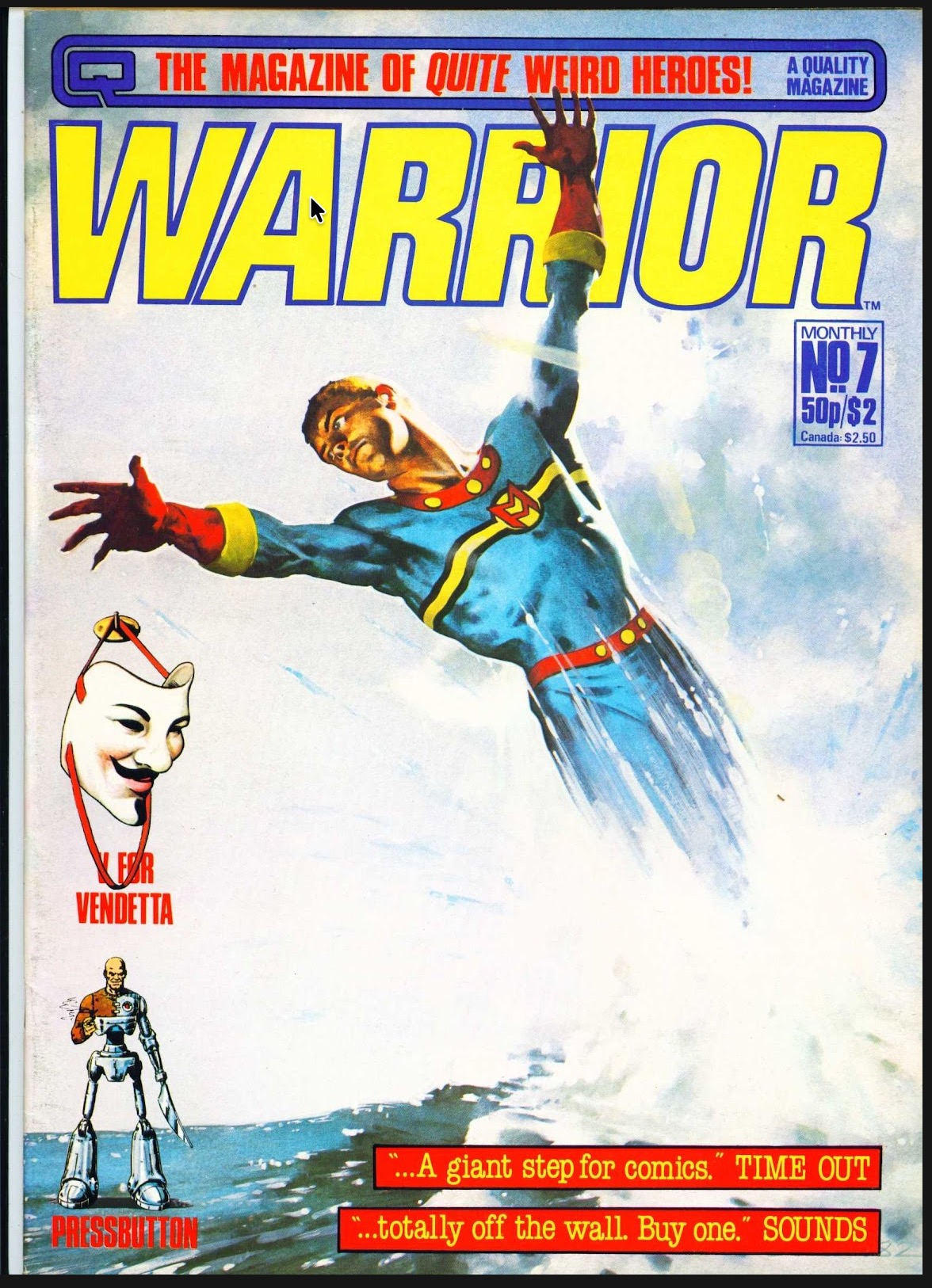
We can’t talk about the Dark Age of Comics without talking about Alan Moore, so today we’re diving into Warrior Magazine, the anthology that first published Alan Moore’s groundbreaking V for Vendetta and Marvelman comics. Previously, Moore had worked mostly on humor strips comics and short sci-fi stories. Warrior gave Moore his first shot at writing the more serious, long-form superhero comics that he’s known for today. In this episode, we look at some of the background and context of Warrior, Moore’s work inside of it, and some of the other stories published inside.
Subscribe to the podcast feed or find it on Spotify, Apple Podcasts, or your favorite podcast app.
Credits:
Hosts: Klint Finley and John Ekleberry
Music: Krudler
Show notes
(02:24) Maxwell the Magic Cat was published weekly in the Northants Post from 1979 to 1986. The strips were collected by Acme Press in single issues from 1986-1987.
(05:31) Paul Neary was the editor-in-chief of Marvel UK from 1990 to 1993, which is the period that the company published a bunch of color, US-sized non-anthology titles that were also distributed in the US. Death’s Head II by Dan Abnett and Liam Sharp is probably the most notable, but Warheads, created by Neary and Gary Erskine and executed by various creators, is a personal favorite of mine.
(6:41) Elizabeth Sandifer was a bit more forgiving of Moore’s work than I remember. I should also note that before “Stars My Degredation,” Moore did a strip in Sounds called “Roscoe Moscow.” You can find the first book of Last War in Albion here.
(08:16) Axel Pressbutton first appeared in “Three Eyes McGurk and His Death Planet Commandos” in the music magazine Black Star issues 22-25, 1979–1980.
(19:55) Eclipse also reprinted the first “Father Shandor” story in John Bolton: Halls of Horror issue 2.
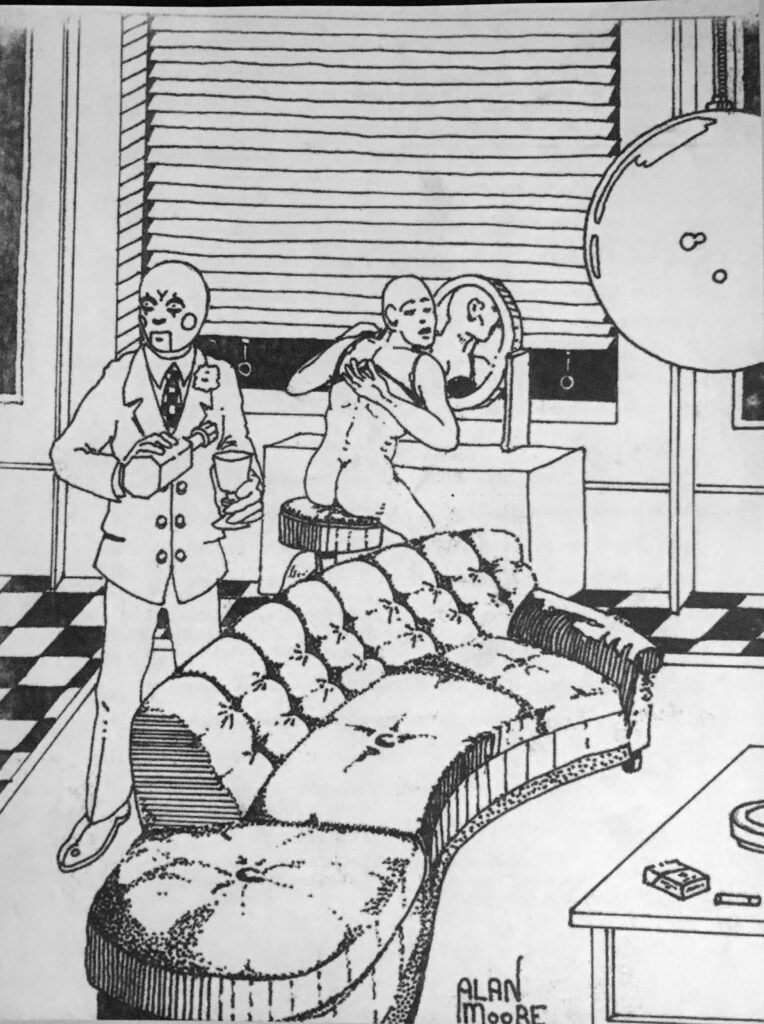
(25:32: You can read Moore’s comments about “Sun Dodgers” in this interview by Lance Parkin. The Doll was a pitch for DC Thompson, Moore described the character as “a freakish terrorist in white-face make-up who traded under the name of the Doll and waged war upon a totalitarian state sometime in the late 1980s.” They appeared on the cover for the third issue of The Northampton Arts Group Magazine, which you can find in Last War in Albion or on page 47 of Magic Words by Parkin.
(35:13) You can find the timeline for the shared universe here. It was originally published in Kimota: A Miracle Man Companion. V for Vendetta is actually described as an alternate timeline where Mickey Moran doesn’t ever remember the magic word. I’m not sure what happens to Kid Marvelman in this timeline…
(40:31): We didn’t mention it, but Steve Moore’s most popular work was probably Abslom Daak, which first appeared in stories written by Steve Moore and drawn by Steve Dillon in Doctor Who Weekly in 1980. Moore and Dillon’s stories were collected in the Marvel UK graphic novel Abslom Daak: Dalek Killer in 1990. Here’s a chapter from Last War on Daak and Axel Pressbutton.
41:31: The books I mentioned here: Unearthing by Alan Moore, Somnium: A Fantastic Romance by Steve Moore, and The Moon and Serpent Bumper Book of Magic by Alan Moore, Steve Moore, and various artists (including Steve Parkhouse, discussed in this episode).
Transcript:
Klint Finley
Welcome to Sewer Mutant, the podcast that doesn’t need a tagline because if you’re listening to this, you probably already know what you’re getting yourself into. I’m your host, Klint Finley. I’m joined as always by my co-host, John Ekleberry. If you want more comic book history, check out sewermutant.com. You can also find John’s James O’Barr collector site at jamesobarr.wordpress.com. Our music is by Krudler and you can find more of his work at krudler.bandcamp.com. And now, on with the show.
Today we’re continuing our ongoing series on the Dark Age of comic books, which roughly covers the North American comic books from the mid 1980s to the end of the 1990s. But we’re setting the stage with some discussions of materials from before the Dark Age. Last episode we discussed Alack Sinner, a comic book series from the 1970s. Now we’re flashing forward to the early 1980s with Warrior Magazine, the anthology that first published Alan Moore’s groundbreaking Marvel Man and V for Vendetta comics.
But first, John, I have a burning question for you: Are you a cat person or a dog person?
John
Cat person.
Klint Finley
Me too. Good. We have that in common. Yeah. No.
John
Hahaha!
Klint Finley
Here we should give the listeners a little bit of information about who we are. We always just jump right into the comics. What makes you more of a cat person, do you think?
John
I’ve had my one cat for like 20 years. She’s a sweetie and then our second one is I don’t know probably eight or something like that, but I had a cat as a kid as well. I’ve never had dogs. I don’t know maybe if I had it all to do over again I would have dogs and learn how to play guitar because women seem to like that, but I am I’m a cat guy.
Klint Finley
Yeah, dogs definitely get you out of the house more and help you meet people, make you take them for walks and stuff. Probably a good healthy option to have. But yeah, I’m a cat person too. But I mean, you can see where some people wouldn’t be a cat people. They kind of just like to torment you. And maybe that’s a good segue into our topic for today because we’re talking about some of Alan Moore’s earliest work and some of that earliest work, though not in Warrior Magazine, was a comic strip called Maxwell the Cat, which he did for his local newspaper.And it was just a pretty straightforward little comic strip about a cat just kind of driving people up the wall.
But yeah, why don’t we get into Warrior. John, do you want to tell us a little bit about what Warrior is?
John
Yeah, so Warrior is an anthology magazine that came out in the early 80s in Britain. The editor was Dez Skinn, who some people like to refer to as like the British Stan Lee. He worked on a lot of projects over there, including stuff from Marvel UK. A whole bunch of artists and writers that we came to know later got their start here Alan Moore, of course you already mentioned and his friend Steve Moore, no relation. Some of the artists in here, of course David Lloyd on V of Vendetta. You’ve got this cool strip called Axle Pressbutton and Laser Eraser and that one has art by Steve Dillon who is a favorite of mine. I love Steve Dillon’s work later on. He also did work for 2000 AD, which I’m sure a lot of these guys did. They probably worked for both. And then there’s a few different artists on Marvel Man. Gary Leach, Alan Davis, also fantastic artists that we see pop up later in both UK and American comics.
I like anthologies anyway. I’m a big fan of Caliber Presents, which we might talk about at some point. Marvel Comics Presents was something that I bought when I first started buying comic books and got into that. I’ve got the whole run of that. But this is a pretty cool series. And the Alan Moore stuff in particular is great, but there’s other good stuff in here too. There’s long running strips. There’s four really kind of core long running strips. And then there’s some one-offs and then a few that just pop up here and there.
Klint Finley
Yeah, and we should ask some context for for listeners who might not be familiar with British comics. The anthology is kind of the dominant form there, especially back then. Or maybe it’s maybe it’s less so now, I’m not sure. But in the in the 70s and and early 80s, most comic books there, as far as I can tell, were black and white anthology comics that were published generally weekly and just had several short strips. And the Marvel UK ones tended to have reprints from American Marvel comics, but printed in black and white, along with original stuff by British creators like Steve Moore and Dave Gibbons and Steve Dillon and others.
So most of these creators who were in Warrior also worked for Dez Skinn on a weekly anthology called Hulk comic that obviously featured the Hulk, but also some other characters. it seems like Dez Skinn kind of tried to lift and shift a bunch of the creators from that onto similar stories in Warrior.
I’m kind of running through it. So you mentioned Marvel Man and Axel Pressbutton. There’s also Spiral Path by Steve Parkhouse that runs through most of the issues that we’re talking about today. I should also mention we’re talking about issues one through 12 today, and we’ll talk about the rest of the run in a follow-up episode. What else is there? There’s Shandor by Steve Moore and John Bolton. And there’s Madman, I forget the artist on that…
John
Paul Neary, I think that one had, think six installments. Yeah. Starting an issue too.
Klint Finley
Yeah. Paul Neary would go on to actually run Marvel UK, think, or be one of the head editors at Marvel UK much later on.
John
I remember seeing his name on, I was buying the, the Death’s Head II stuff when it was coming out in the nineties, but I did notice I went back and read the older Death’s Head stuff and Geoff Senior, is the author or the artist on those. And he did that character in the UK Transformers comic as well. And his name pops up in Warrior here. He does, just some guest inks on Spiral Path. And like one of the one of the chapters, I just happened to notice it today, but you know, all these creators probably knew each other and were working together.
Klint Finley
Yeah, yeah. you said, most of them had worked on Hulk comic. Alan Moore and maybe John Bolton are the outliers there. And then most of them had also worked on, on 2000AD at some point and, and other places. So at this point in, in Moore’s career, he had done, he started out doing a lot of kind of underground comics. He actually wrote and drew his early stuff. And it’s interesting to me that, um, he said he stopped because he wasn’t that good. And Elizabeth Sandifer, who is doing this kind of ongoing book project that the first book of it has already been published, The Last War in Albion, which is about the rivalry between Alan Moore and Grant Morrison, but is also basically like an occult history of 20th century and 21st century pop culture.
She was kind of dismissive, I think, of Moore’s artistic talent. To be honest, when I look at his old stuff, I think if I was alive back then and somebody told me that in the future, this creator was going to become famous and like one of the most respected people in his field for either the writing or art or drawing, I would have guessed probably the drawing because I don’t know. I wasn’t that taken by a lot of those early strips that he did. But they were more like humorous kind of gag strips and stuff, not really what he would go on to be known for, doing serious, long form dramatic work. And that really starts here in Warrior. Before this, he had switched over to writing and he’d done some short stuff for Doctor Who Weekly, for Empire Strikes Back Weekly, and of course, 2000AD, but Marvel Man and V for Vendetta are the beginnings of the Alan Moore we know and love today, I think. And so that’s the big reason that we’re exploring this. But it’s interesting to look at the other stories here too for some of that historic context. So Steve Moore was not just Alan Moore’s friend, but really his mentor who helped him get started in the industry, actually took over writing some stuff that Moore drew in those early underground days when Moore was busy or dispirited. So that’s actually where Axel Pressbutton comes from, were some strips that Steve Moore filled in on in, think that was, those were in Black Star Magazine, where some of the art for something that Alan Moore had finished were stolen out of an editor’s car. And Moore just was kind of, not sure how to proceed or didn’t want to redraw what he had already done. So Steve Moore wrote this story, I think it was called Four Eyes McGurk, and it had Axel Pressbutton as one of the characters. Then later, Moore was doing for Sounds Magazine, was an alternative magazine in Britain, a series called The Star Is My Degradation. That was a humorous sci-fi space opera type thing that Steve Moore ended up taking over the writing on with Alan Moore continuing to draw, which is still just kind of an odd thing that see Alan Moore drawing but not writing something. And that reintroduced Axel Pressbutton. And so then the character returns again in Warrior, but now drawn by Steve Dillon in some of Steve Dillon’s fairly early work when he was quite young when he was doing this.
He had also worked on Hulk comic doing Nick Fury with Steve Moore, starting when he was, I think, 16 years old. And looking at that early Steve Dillon stuff, it’s really impressive how talented he was so early on. Maybe that’s why Alan Moore and Grant Morrison got dispirited with their drawing that they saw how good Steve Dillon was already at his age.
John
I have to imagine that it’s true, right? Like when you’re comparing with your peers and somebody’s just really super strong out of the gate. Like for me, Dylan is kind of one of the greats. mean, not everybody’s a super fan of him, but like, man, I’ve loved everything that I’ve ever read that he’s illustrated. He’s just fantastic. And there’s more stuff out there still for me to explore. I mean, unfortunately, he’s gone now, but he’s left a huge body of work behind. And so there’s other stuff for me to read.
Klint Finley
Yeah, I’ve always liked him, but I don’t know, I was never like a super fan of his work, but there’s something about maybe seeing these black and white pages in for Axl Pressbutton and there’s something like just really beautiful and flowy about how they are presented that I can’t put my finger on that just make them better than, I mean, it’s a fairly silly comic with just a lot of kind of gratuitous violence and it’s not particularly funny. I don’t know. It is what it is. But Steve Dillon’s work on it just elevates it in a way. And it’s one of the better strips in Warrior that isn’t by Alan Moore.
John
And it gets the cover spot on the first issue, probably because it had already appeared, you know, and it had a little bit of recognition for readers. Also, I don’t know exactly how much lead time they had, but in the editorial in the first issue, they talk about taking some extra time to get everything right for this first issue so that they’d be super strong out the gate. And it really is. I mean, like this first issue was very strong, like across the board.
Klint Finley
Yeah. Yeah, yeah, think it’s really solid. This also has a non-ongoing strip that was by Steve Moore and Dave Gibbons. Dave Gibbons is in there, Steve Bolton is in there, Steve Dillon is in there, both of the Moores are in there, Steve Parkhouse who, I don’t know, I don’t think he’s super well known in the US or anything. I don’t know that he really carried over a whole lot, he was, it seems like he was a fairly big deal in the UK at that point in time. He had done Black Knight in Hulk comic and that featured Captain Britain and led into the story arc that Alan Moore ended up taking over on Captain Britain. David Lloyd obviously doing V for Vendetta, he’d done a lot of work in the British scene already, including some work with Alan Moore on Doctor Who. So it was a really solid lineup of creators. And even if some of these stories kind of fell off, like I think neither of us was very excited about Shandor, especially after John Bolton stopped drawing it, for me at least. Nonetheless, it starts really strong.
John
Yeah, I think the John Bolton segments are pretty cool. And I actually think the art throughout is fine. Even after he leaves, I think the art’s pretty strong in this, it kind of became a slog to read that one, I feel like. I kind of fell off. When I first started reading these, I was trying to consume them as complete issues. So I’d read all of issue one and then all of issue two. But then what I found you know, going forward is I started to get a little more anxious to read the strips that I liked. And so I would read like, you know, all I’d go through and all of Marvel Man, and all of each of Vendetta and then all of Spiral Path. And I didn’t actually make it through Father Shandor, but I probably when we talk about the back half. Well, I’ll circle around to it and talk about it some more because those are the four main strips.
Spiral Path, though, is in these first 12 issues, and then that’s it. It actually has a whole concluding story, and then it doesn’t appear in the second year of the magazine. It’s replaced by a few other things. But Shandor does continue, so there’s more Shandor to read going into the future. And then, of course, Marvel Man and V continue as well. V is the most represented strip. 25 of the 26 issues. And I think Marvel Man’s something like 20. So, yeah, Spiral Path’s kind of interesting though. Spiral Path, the Steve Parkhouse one, reading it and it’s it’s kind of interesting it’s not it didn’t have any like super highs or lows for me it’s it’s kind of episodic and some of the episodes when you get to episode 12 and you realize that’s the whole like the whole story you think well they like spend a lot of time on like this one segment that doesn’t seem like it has that much to do with the rest of it but I don’t I don’t know what what did you what did you think about Spiral Path?
Klint Finley
Yeah. I so it’s odd. don’t think it hangs together very well as a whole story. I think if you were to just read it as like I actually bought the Eclipse reprints of it. And I think if you were to just read those issues as a straight story, it would just be like, “what is this?” It kind of jumps from one thing to another. It’s not very like the conclusion isn’t very satisfying. Parts of it seem rushed and other parts of it seem drawn out. And yet reading it in issue to issue, in with all the other stuff that’s in Warrior, I found it surprisingly readable and enjoyable reading it that way, where each segment was just kind of a fun little thing to read in between other, just other strips, other stories. And I don’t know. Yeah. It spoke to me, I guess, a little bit, even though I can see that it’s not really that good from a writing standpoint. The art I thought was good, I mean, Parkhouse is up against some real heavyweights in Warrior. And in terms of like the fantasy stuff, even though I think I enjoyed reading Spiral Path a lot more than Shandor. I mean, I keep mentioning Sean Bolton, but I mean, he’s he was just so good that I would, you know, it’s it’s hard not to compare Parkhouse to him when they’re when they’re both doing those the same kind of genre of comic and those, you know, right in the same pages. So, you know, fairly good. And I think now we can maybe get into the Alan Moore of it all. V for Vendetta, you mentioned to me that that you thought that it was some of the strongest storytelling you’d ever seen in those first…
John
Yeah, I think the first installment in particular just sucked me in in a way that I mean, I’ve liked V from before, but it’s been years since I’ve read it. And I don’t know the power of the art and I think the really heavy black lines and the storytelling and the sense of motion. It’s funny because we talked about it and I don’t think that it hit you the same way it did me. In fact, I think you like it less than you used to like it, but for whatever reason, V to me was just really, really strong. I thought that Marvel Man would be my favorite thing. And I do really like Marvel Man. But V for sure is like the cream of the crop for me when it comes to the strips in here. Marvel Man’s like really weird. We’ll talk about that in a minute too. But the first couple episodes are super strong. But then like it gets a little strange. Like it really kind of goes in some weird directions. And when you’re doing a serial like this and you’re doing, you know, like eight pages at a time or whatever, I can see how that could happen because they just have to be like, okay, well, you know, what are we going to do this month with our, know, especially if he’s writing multiple strips, like, you know, Alan Moore was writing, V and Miracle Man. And then also, some of the other like one shots or whatever that came along the way.
Klint Finley
Yeah, plus he was doing Captain Britain. He was still doing Maxwell the Magic Cat. He was still doing Stars, My Degradation for at least some of that time. He was doing lots of stuff for 2000 AD at that time. After he started doing Marvel Man and V for Vendetta in Warrior, 2000AD finally gave him his first ongoing story in 2000 AD, which was Skizz, which was kind of a ET knockoff
John
I read that. Yeah, okay.
Klint Finley
And then also DR and Quinch. So he had a pretty full plate when he was, when he was doing all of these, it’s pretty impressive amount of output. Yeah. Yeah. V didn’t hit me quite the same way revisiting it. So I mean, the first time I read it, I was a freshman in college and I actually read it was almost 25 years to the day when I started rereading it, because I started my reread in November. And I remember it was Thanksgiving break when I read V for Vinda the first time in 2000. So that was a big, long break to come back to. I started warming up to it more as it went on, but the earlier strips didn’t strike me that well, especially not compared to how I remembered, how strong I remembered it being before. And then the other thing is it’s interesting to look at some of this stuff that in black and white where I think Marvel Man definitely needs color. It’s a superhero story. He’s got the blue suit that just really pops. Just needs, it should be in color. They have to keep like mentioning, what’s his name? Mr. [Cream]
John
He’s so weird, yeah. Yeah, that’s an interesting character.
Klint Finley
Yeah, they have to keep mentioning that his teeth are like that blue sapphire color because it’s black and white, so they have to tell you the color. It’s kind of weird. And in V, it’s interesting because I think it’s intentional, but the artwork gets murky to me because when it’s only black and white, a lot of the, like everything starts to blend, a lot of the things start to blend together and it gets kind of hard to see the action at times or see what things are or tell what things are.
John
It feels like this strip is in perpetual night and I don’t know if it’s necessarily supposed to be all set at night in the storyline, but it feels that way.
Klint Finley
Yeah, for sure.
John
Which is kind of interesting in and of itself. But yeah, I think that this story’s probably both benefited from color, Marvel Man more so than V. I kind of like it in black and white, but it’s interesting that they both got exported and then colored later by Eclipse, right? And then both continued too because if you read through all of Warrior, that’s not the end for either of those characters. They both got additional material from Moore for the follow-up series.
Klint Finley
Right, yeah, think V was colored by DC, not by Eclipse.
John
Yes, you’re correct. You’re correct. Eclipse did Marvel Man.
Klint
So most of the other stuff that, yeah, most of the stuff from Warrior that got reprinted was Eclipse. But yeah, V for Vendetta is the exception there.
John
I wonder why, I wonder how that broke down. I wonder if, you know, I mean, Moore did work for DC too, but I wonder if maybe David Lloyd also did some kind of DC work that gave him an in there. I wonder why that one wasn’t picked up by Eclipse and the other ones were. It’d be an interesting thing to…
Klint Finley
Yeah, I don’t know. Yeah, so for listeners that are curious, Marvel Man was reprinted by Eclipse in the States as Miracle Man. And they also reprinted Axel Pressbutton and Spiral Path. And you can find a lot of those issues for fairly cheap if you’re interested. And actually, the Warrior magazines, apart from some of the early ones, are not, not too terribly expensive on the back issue market. So this stuff is definitely findable, but it’s, you can also easily find, scans of it, which is how I’ve been mostly reading it. I, hate to do that, but, for, for these, was a kind of a big undertaking. I did buy some of them. I think John, got all of them. Yeah.
John
Well, sometimes you have to, sometimes you have to. I, I owned like the first maybe six issues prior and they were in pretty nice shape and I’m really, really kicking myself. You know, I’ve, I’ve bought and sold a lot of, a lot of things over the years, a lot of comics, and I wish I hadn’t sold those. I sold them for kind of a stupid reason. They’re, they’re too big to fit in regular US magazine size boxes. They’re a little bit bigger. And so I didn’t have like, a great way to store the ones that I had in with the rest of my collection. And so it was one of the things that I cut because I was like, well, I’ve got, you know, I’ve got the Eclipse printings and the DC printings of you know, of Miracle Man and V, maybe I don’t need them. And then I just like when we started talking about it, really wish that I had them again. And then I got lucky and I found somebody that had a complete set of of all 26 issues and I just bought them from them. So.
Klint Finley
Yeah.
John
I mean, if you try to buy them singly, the first issue is really expensive now, but the rest of them aren’t that bad.
Klint Finley
Yeah. So Marvel Man for me was kind of the opposite experience of V because I also read the first Eclipse trade paperback of that in college, which is kind of crazy in retrospect because I think it was selling on the back issue market for like $400 at that point and somebody just lent it to me. But I didn’t really like it. I thought it was I thought I remember finding it kind of dull and I think it in retrospect, probably it was an issue with pacing. And I think it has a lot to do with having to break the story down into those eight page chunks where you’re kind of constantly having to recap things. And Marvelman doesn’t do, it’s not too bad about that where it’s, you know, it doesn’t have somebody like restating the entire plot of the previous installments in the first few panels of every installment, but it’s still there’s still rehashing of things more frequently than you might want. And having the cliffhanger type ending every eight pages is weird that it doesn’t make it more exciting. It actually kind of makes it slower to get through somehow, which is kind of surprising. But that’s how it works, I guess.
But yeah, I ended up liking it more this time around. I guess I also was kind of, or maybe a little bit the opposite of you, I thought it started a little bit slow. But then once Kid Marvel Man shows up, and I think that’s the third chapter, I thought it got a lot more interesting there. Like when, it like the plot really started there and the first couple were just kind of setting things up. And then the story really starts, starts moving. I actually don’t remember any of that from reading it before. I even wonder if maybe I gave up too early into it or something, but didn’t finish it.
John
I only have the first six issues of the Eclipse run because they were the cheap ones. And for those later issues, the ones that have the content, I think probably the content that’s not in Warrior that came later, especially that last issue, issue 15 was like, or at least the last Alan Moore issue anyway, was super expensive for a really long time. And then years and years and years later, Marvel acquired the rights and reprinted it again. And I really. I don’t know. I bought some of those, but I didn’t like the colors that much in them, and it was really kind of weird to have it on the super glossy paper and all that. I’d like to get the rest of the Eclipse issues at some point and read them.
Klint Finley
Yeah, the Eclipse color is definitely the better version. I think those are the definitive versions of the book, or of Miracle Man anyway, of Marvel Man slash Miracle Man is those eclipse ones. Yeah, you said, yeah, starts getting weird after those first couple chapters of setup. Yeah, I mean, we’re really getting Alan Moore finally kind of getting to start to realize some of his ideas.
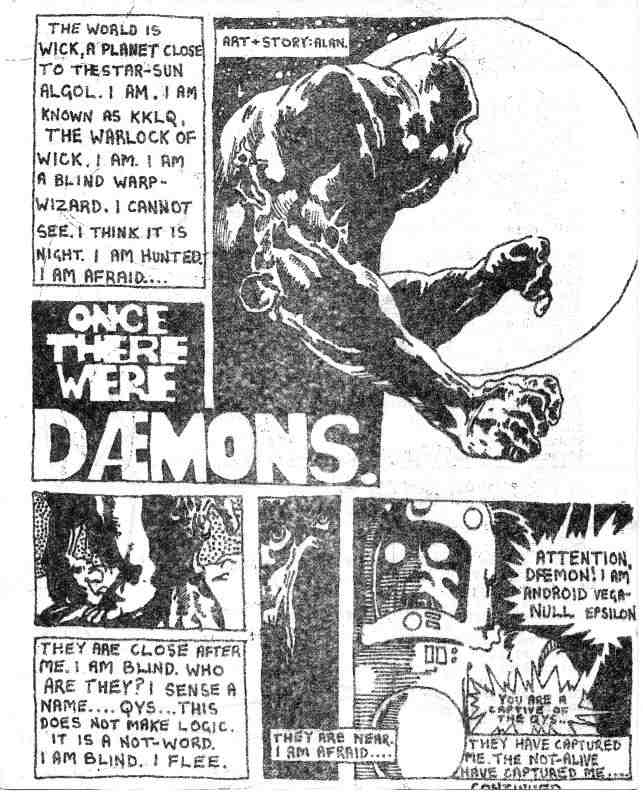
One of the interesting things, some of his very first work is it was in a poetry magazine that he edited when he was a teenager, his late teens. It was called Embryo. And the fourth issue of that, mostly it’s poems and drawings by him and his friends. The fourth one actually has a comic that’s like three or four pages long. And it’s called Once There Were Daemons. And I couldn’t quite follow the story in it, but it’s about this guy waking up on a ship or somewhere in the future or something like that and in like a cryo chamber and someone’s speaking to him telepathically. But he’s being menaced by some sort of entities called the Qys, like Q,Y,S. and either he or somebody else in it, it’s not very clear, identified as “Warp Wizards.” And so then in the the warrior summer special, which is also Warrior issue four, there’s a Marvel Man story where that takes place in the future and it has the Warpsmiths. Then the Warpsmiths get some of their own stories a little bit later in Warrior. And it reveals that they’re in this conflict with these alien creatures called the Qys. Again, spelled the same way, Q-Y-S. So he’s got this idea from when he was a teen that he finally is bringing into Marvel Man years and years later.
And then in Lance Perkins’ biography of Alan Moore, actually explains some of the origins of Moore’s idea on Marvel Man is that he picked up like a Mad Magazine anthology that had the Super Duper Man parody in it and an old issue of Marvel Man. And he had his own idea for like a Marvel Man parody where Marvel Man was grown up or the guy that turns into Marvel Man is grown up and can’t remember the magic word that turns him into Marvel Man. And so he kept that idea from when he was a kid all the way up to
John
Awesome.
Klint Finley
all the way up into into warrior. There’s also in the biography, it explains that he had this big plan that he wanted to do a space opera series. I think it was called Sun Dodgers that he wanted to do for 2000 A.D. But it was just like too big of a project for an unproven writer. But it had all these all these characters in it. And some of those characters ended up turning up in his Doctor Who comics in the 4D war as the Special Executive. And then the Special Executive also came up in his Captain Britain run. there was also one of the characters from Sun Dodgers was supposed to be a character who had been experimented on in “Room 5.” And so you can see the echoes of that in V for Vendetta.
John
Absolutely.
Klint Finley
And he also had done a pitch for a British publisher when he just out not long after I think he was expelled from high school. I think it was called the Doll. And the idea was there was going to be some sort of like transvestite anarchist character who wore a like a porcelain mask or something like that. There’s just, you he can see him taking all these ideas that have been stewing around. I mean, Axel Pressbutton is even kind of the same way of for Steve Moore, just a character that had been floating around in these underground comics for years and years and then finally got the right format, the right venue to fully explore in the right way.
John
I like that idea that they kind of, and maybe that’s part of why it feels as strong as it does because it’s more fully formed idea of something that they’d already explored before. I mean, I’m sure our listeners already know the history of Marvel Man, but for anybody that doesn’t, the very quick rundown is that of course there was, in the beginning, was Superman. And then Fawcett Comics made a Superman knockoff called Shazam, who is now owned by DC many years later after they sued Fawcett and got the rights to it. And the only real difference between Shazam and Superman is that Shazam’s like a magical character. And so he’s a kid, Billy Batson, that says a magic word, Shazam, and he becomes Captain Marvel. And in England, they ran out of Captain Marvel reprints and they wanted more. So they got a guy, Mick Anglo, to continue the series, but they had to tweak it a little bit. And so he came up with this character, Marvel Man, who’s just a knockoff of Shazam. He’s the same thing, but the names are changed or whatever. Now instead of Billy Batson, he’s Mickey Moran. And the word that he says is Kimota, which is atomic backwards.
And I love the scene in the first strip in Warrior one where Mickey is at the atomic plant and it’s attacked by terrorists and he just happens to see the glass door that says Atomic, but he sees it from the back and he just says it. And he hasn’t turned into Marvel Man in years, in 20 years or something. Of course the story goes from there and it’s great. But that’s the genesis of that. So he’s basically the British Shazam. And he’d been out of print for a while. He was popular in the fifties until those reprints ran out, maybe even into the early sixties when it finally wrapped up. But it would have been something that Moore, Alan Moore read as a kid. And so for him, it’s, you know, something that he’s, he’s like revitalizing and revisiting. But of course he’s putting this more dark revisionist take of it, which of course is what we’re talking about here with the Dark Age of Comics.
Klint Finley
Yeah, well, I want to push back a little bit on the idea that Captain Marvel is a ripoff of Superman and there’s not any difference beyond that being a kid who says a magic word. I mean that is a pretty big difference between the two characters that Superman is an adult with a grownup job and all the trappings and responsibilities of an adult. Whereas Billy Batson… Well, now that you mention it, he also is a reporter. But he’s a kid reporter and he’s a kid.
John
Yeah, he’s yeah, they well what they did is they basically took the Superman character and then the kids sidekick character and like made him one character, right? They made him more relatable to kids. But like it but but visually they definitely like that was the ripoff of Superman. But yeah, they did a lot. They did a lot to build a different mythology for him, though. And then they had, of course, the whole family of characters, which Superman has a family of characters. So did So did Shazam and so does Marvel Man. What Alan Moore does with the Marvel family is kind of interesting.
Klint Finley
Yeah. But where I was going with that is that the original Captain Marvel and Marvel Man has that appeal to kids where this fantasy idea that you could be Captain Marvel or Marvel Man too if you knew the magic word. You still get to be a kid when you want to be, but you could also transform into this incredibly powerful persona that has all the power of an adult with none of the responsibilities of an adult, which is a pretty potent thing for kids.
Grant Morrison in Super Gods points out that Moore’s version of Marvel Man inverts that fantasy where Mickey, he’s an adult, he’s in his middle, he’s like middle aged, he’s older. And when he transforms into Marvel Man, he becomes, it’s basically becoming younger, more vital and regaining his, his looks, his strength from, from when he was more youthful, or strength that maybe he never had. So it becomes a fantasy for adults to become younger and more, more strapping and powerful.
John
Right.
Klint Finley
And rather than a fantasy for kids to become an adult, which I found really interesting given that Warrior is kind of aimed more at, was aimed at more of an adult audience.
John
Well, and you know, kind of see that in like in like Dark Knight Returns too, right? Like Batman is perpetually, you know, he’s a he’s a kid that loses his parents and he grows up and he trains and then he’s perpetually like 20 or 30 years old forever. But when Miller wrote him, he said, no, like I can’t. Batman’s not going to be, you know, younger than me. Like I got to I got to do old Batman. And so Dark Knight Returns becomes about Batman trying to be young again, basically. Right. Like he’s. He’s an old guy, but he tries to relive his, you know, with some success.
Klint Finley
Yeah, no, it’s, mean, he’s like 50 years old or 60 or however old he’s supposed to be. They never really make that clear, but he’s much older and still like the biggest badass in Gotham and beats up Superman. It’s, yeah, that’s, yeah, that’s interesting. It’s kind of the fantasy of like, yeah, you can be an old guy and still be the toughest son of a bitch in town.
John
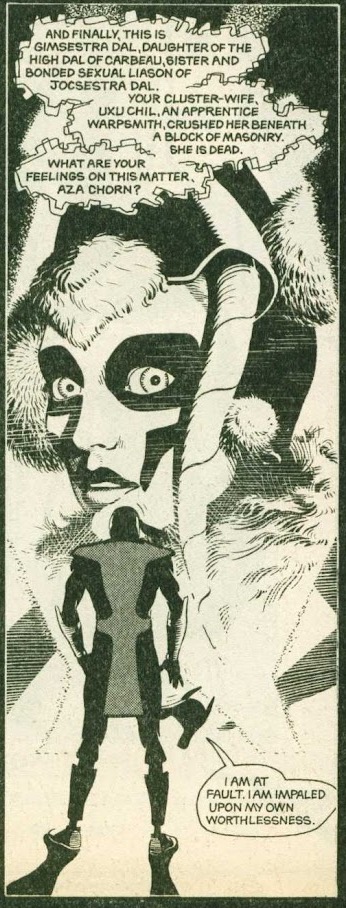
Yeah, it’s very cool. There’s a, I don’t know, there’s a lot of great stuff in here. So is there, I don’t know, is there anything in Warrior that we didn’t talk about that you feel like we should? I feel like some of the one-offs are fun. There’s like a little time loop story in the first one and there’s some other little ones here and there. The two-part Warpsmith story was okay. Like I didn’t love like the jargon-ish writing that Moore tried to do for like their speaking. Like I got what he was going for.
It was funny, there was one line in it that was really funny though. There’s one of the Warpsmiths is being chastised by his like superiors for like screwing up. And he says, “I am at fault. I am impaled upon my own worthlessness.” And I’m just going to start saying that like when I make a mistake.
Klint Finley
Yeah, no, I agree. It’s mostly, I think those were interesting just to see that where Moore was taking those earlier ideas that trace so far back for him rather than for, I guess, for them in and of themselves. Yeah, I guess we didn’t talk about it yet because there’s also the Bo Jefferies Saga that starts in issue 12. And I think that doesn’t, it’s one that’s weird that’s on the cusp because most everything like finished either concluded entirely like Spiral Path or finished their first chapters or their first storylines in issue 12. And then 13 is kind of new stuff picking up, but the Bo Jefferies Saga starts in 12.
John
Sure, yeah.
Klint Finley
Feels like more getting back to those underground roots doing something that’s more silly and humorous. He works with Steve Parkhouse on that. He was fresh off of Spiral Path doing something completely different from Spiral Path.
John
Completely, just totally different style. And I was aware of B Jeffries saga from one of the reprints, but wasn’t aware that it was one of the Warrior strips until we did this. Yeah, it’s a weird little one. I mean, I didn’t super love it just because it’s not aesthetically like what I care about, but I saw what they were going for with it. It was kind of interesting. And there’s a few, I think it pops up in four, maybe four issues. There’s not a ton. It doesn’t go on forever. Spiral Path ends in issue 12 and it never reappears in the magazine. And the next longest running strip is Big Ben later on, which is a character that gets spun out of, spun out of Marvel Man. And Dez Skinn writes the Big Ben strip.
Klint Finley
Something that’s interesting about Warrior is that it is supposed to be a shared universe where I guess Shandor is the distant past and then Marvel Man is the present, V for Vendetta is the near future and Axel Pressbutton is the far future. And the two Moores had like a big timeline of everything that was involved. That was another place where it kind of tied into Moore’s Doctor Who stuff because his work there was the 4D war where it was this conflict between the Time Lords from the Doctor Who universe and some sort of group that I think was called like the Order of the Black Sun. And it seems like he just kind of took that and put it into the Marvel Man past where it was a conflict between the Warp Smiths and some sort of time travelers. And that’s part of the whole timeline that he had worked out. There’s been a lot of speculation that the plan was that V was Marvel Man. But yeah, I don’t.
John
Yeah, that’s really cool. Really? That’s kind of an interesting thought. I mean I probably like that they’re not the same, but at the same time like the origins are I guess kind of similar. I never really thought about it, but you know in the Marvel Man strip he’s he thinks he has this fantastical origin because he remembers the the origin from the original comic book, but it turns out of course, you know, that it’s all more nefarious than that and that he was, you know, created in the lab and whatever. And so was V. He was, he was like experimented on in the concentration camp and you never see his face and you never know who he is. And so they, they potentially could have, I guess, been the same characters and the timeline thing’s interesting too. Not only merging all the strips, but looping back around to Axel Pressbutton. They wanted all of the Axle Pressbutton stuff to be in an actual timeline. So like the stuff in my Star my Degradation and, the other strips that he was in, were like later in his life or whatever. And this is like earlier, the stuff that’s in Warrior. And, yeah, it’s, it’s all pretty cool. There’s a, I can’t remember which issue it was, but in one of the issues, Steve Moore does a whole, has a whole like segment about how everything’s connected.
We didn’t really talk that much about V for Vendetta during this episode, but I think it’s well known enough that people probably get it. But man, I love David Lloyd’s art in it and I love the storytelling in it. I think it’s the strongest strip in the whole thing, and it’s the most prevalent strip. So I’ll get to read more V as we go into the second half, but I’m pretty excited to read the back half of Warrior and talk about it.
Klint Finley
Yeah, if I had to pick a favorite, I probably would go with Marvel Man over V, but they’re both strong, even if I found that a little hard to get started with them this time around. They both grew on me a lot, and I think they’re, yeah, they’re both really strong. You can see the influence of them rippling across the ages, if you will. And that’s something we can talk about it next time, as well as kind of some of the impact and influence that these stories had on other creators and on the establishment of the Dark Age of Comics. Actually, one other thing I would touch on is Alan Davis as an artist. He was somebody who I was a little bit familiar with. I’d read some of his Excalibur issues that he did with Chris Claremont, not his solo ones. But seeing the, his work on Marvel Man and Captain Britain really just drove home how incredible of an artist he is. And I think he’s possibly the most underrated artist in comics, but he’s certainly one of the most underrated.
John
Yeah, he’s a master. He’s fantastic. I’ve enjoyed his stuff. I enjoyed the Captain Britain run. I read that when it got reprinted in trade paperback over here, like, I don’t know, probably 25 years ago now, which is crazy. It’s crazy that it’s that long ago. You were talking about how you read V first in like 2000, I think you said, and I probably read it in 95 or something like that. like, it’s a you know, it goes, it’s as old as we are, because I mean, this this magazine came out when I was like being born, like I was born in 1981. So these these characters are as old as we are. But which is a little hard to wrap my head around when I look back. But this is a really foundational piece, I think, of the puzzle.
Klint Finley
Yeah. And we’ll dive into it even more in the future. Know what? Maybe we could loop back to Steve Dillon real quick. Steve Dillon actually has a brother whose name suddenly escapes me, but he did a book called The Nao of Brown, which is spelled N-A-O of Brown that is more of a slice of life comic. It’s not very similar to the work that Steve Dillon did, but I think any listeners who are Steve Dillon fans should really seek out his brother’s work as well.
John
Glyn Dillon is his name, G-L-Y-N. But the weird factoid that I noticed was that he designed the Batsuit for the most recent Batman movie, the Matt Reeves movie, The Batman. So that’s kind of a cool thing, yeah. That’s pretty neat.
Klint Finley
Right, right, yeah, he’s a concept artist. Yeah, yeah. And I guess we could maybe say a little bit more about Steve Moore, Alan Moore’s mentor. know, this warrior really does seem to be one of the main kind of bodies of work that he, like enduring bodies of work that he produced. he didn’t, unlike a lot of the other…
creators here, he didn’t really go on to have a big career in American comics or do like a Vertigo series or anything. He did some work on Moore’s America’s Best Comics imprint later. But yeah, he’s I guess in a way Axel Pressbutton and Shandor are his some of his longest running biggest works. So this is it’s worth keeping that in mind as we dive into it.
John
Alan Moore wanted to hand over his run on Supreme to Steve Moore. And Rob Liefeld said, I’m paying for Alan Moore, not Steve Moore. Which is like kind of, kind of like, cause he probably didn’t like, no, well, I mean, for one, Alan Moore is just, the, the, all the clout and all the name recognition, but Steve Moore wasn’t a nobody. I mean, he had been in comics just as long. And like you said, he was a, a mentor even to Alan Moore. so, you know, and he ended up getting a little bit of work here and there through Alan Moore, like writing the novelization of the V for Vendetta film and things like that.
Klint Finley
Yeah. Yeah, his other kind of big work, he passed away in, I believe, 2014. His other major work is a novel. Well, actually, Alan Moore did a graphic, not a graphic novel, an illustrated book and audio book about Steve Moore’s life.
John
Was it the magic one about the serpent and the whatever? Or is that something else?
Klint Finley
You’re talking about the Moon and Serpent Bumper Book of Magic, that was a collaboration with Alan Moore. And that, guess, is actually would be Steve Moore’s final posthumous work. And that’s like a book on the history of magic and magic, that they started work in something like sometime in the aughts, I think. Alan Moore finally finished it it was published in 2024. Unearthing is the thing I was talking about. That’s of an extended essay on Steven Moore’s life written by Alan Moore. And a lot of it focuses on Steve Moore’s own experiments and works in the occult, which both Moores were practitioners of.
Steve Moore’s other major work I think would be his novel Somnium that was published in 2011. If any listeners want to go deeper on Steve Moore.
John
I’ll have to check that out. Oh, with an afterword by Alan Moore as well. That’s cool. Yeah, I guess we didn’t mention that for Laser Eraser and Pressbutton, Steve Moore used the alias Pedro Henry, which is pretty fun. And so not only did they not have to credit all the strips in Warrior to Moore, because we had a tale of two Moores going on here, but also it was just kind of a fun pseudonym. Then there’s a portion of the magazine where he interviews himself where Steve Moore interviews Peter Henry and he has a back and forth dialogue with himself. So it’s kind of fun.
Klint Finley
Yeah, I think that’s in like issue 15. yeah, we can talk about that next time. Yeah, tune in next time for more on Moore. Well, thanks, John. This has been fun. Always a pleasure. And I’m looking forward to getting into that second half of Warrior.
John
Very cool.
Yeah, I’m jazzed. can’t wait for it. So we’ll we’ll catch everybody next time.