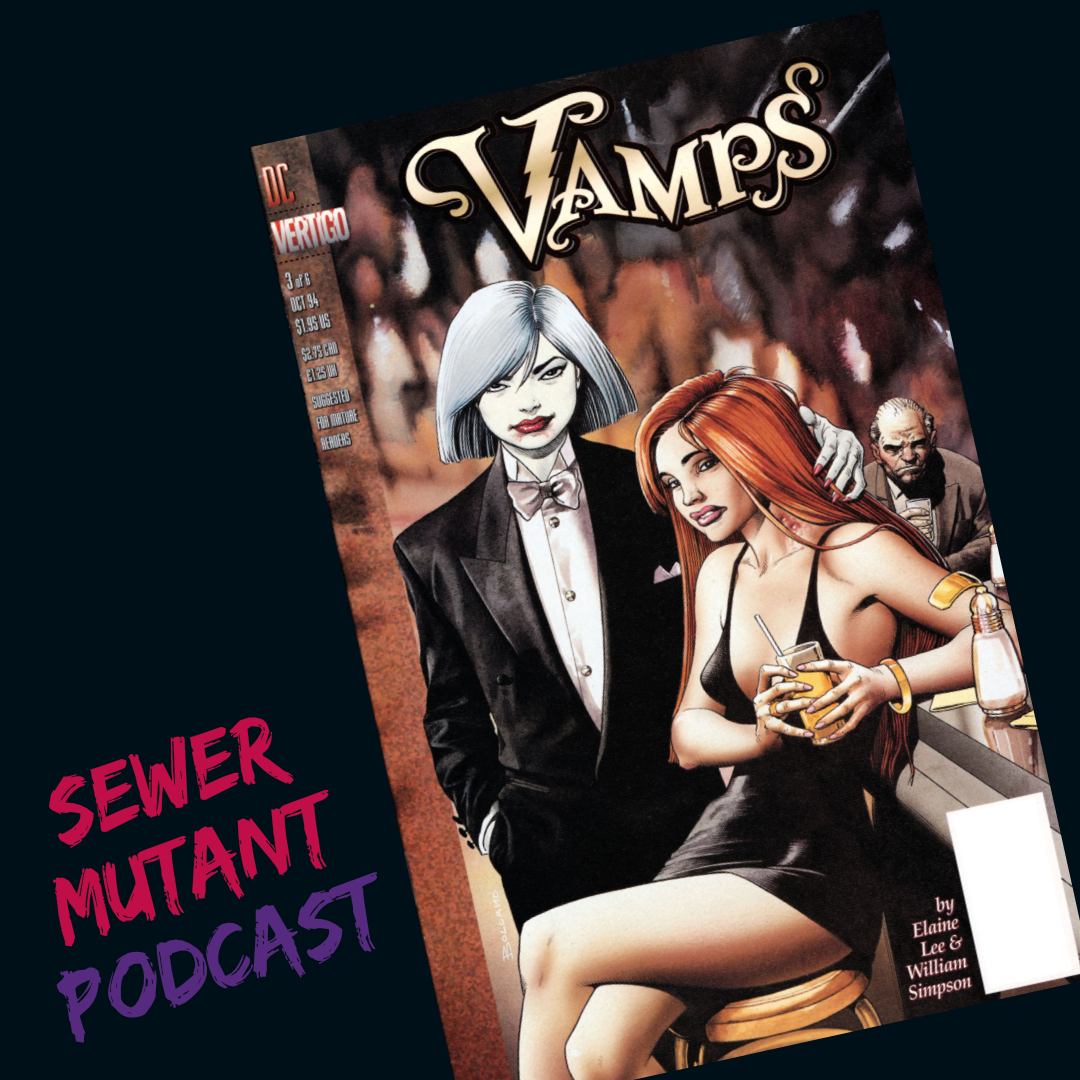
For Halloween, we take a look at Vamps by Elaine Lee and William Simpson, a 1994 comic book from DC’s Vertigo imprint that has a bit of crossover with the 90s Bad Girls trend.
Subscribe to the podcast feed or find it on Spotify, Apple Podcasts, YouTube, or your favorite podcast app.
Credits:
Hosts: Klint Finley and John Ekleberry
Music: krudler.bandcamp.com
Mentioned in this episode:
I still have that Dracula shirt!
William Simpson worked on “Big Ben” from Warrior issues 19-26, starting in 1984.
Simpson went on to be a concept and storyboard artist for film and television, most notably for Game of Thrones.
Elaine Lee was an actress on The Doctors and the writer of Starstruck with Mike Kaluta. Her son is podcaster Brennan Lee Mulligan.
Vamps Assistant editor Julie Rottenberg went on to be a screenwriter and producer on Sex and the City, And Just Like That, and others.
1994: In film: Interview with a Vampire, The Crow, Natural Born Killers, Pulp Fiction, Forest Gump, Shawshank Redemption. Music: The Downward Spiral, Under the Pink, Illmatic, Ill Communication. Kurt Cobain took his life. Events: Murder of Nicole Brown Simpson, the Rwandan Genocide, Nelson Mandela became president of South Africa. Just to name a few things that stood out to me.
We’ll still have two more episodes this year, but instead of covering a single comic they’ll be a little bigger picture, then we’ll take a holiday break and resume the Dark Age coverage in the new year.
Rush transcript:
Klint (00:01.461)
Welcome to Surmutant, the comic book podcast for weirdos like you. Our music is by Krudler, and I’m your host, Klint Finley, joined by my co host, John Ekleberry. John, how are you today?
John (00:11.586)
Doing great.
Klint (00:14.327)
Cool. Yeah. So today for Halloween, we’re continuing our survey of the dark age of comic books, but we’re continuing to do it nonlinearly. so in this episode we’re talking about Vamps, written by Elaine Lee with art by William Simpson, published first in nineteen ninety three. But first let’s do an icebreaker. what do you got for us today, John?
John (00:36.434)
I just wanted to know when the first time you remember encountering fictional vampire, like what was your first exposure?
Klint (00:47.334)
man, I don’t know. I feel like vampires t always been with me, I guess. I don’t that that’s a good question. gosh,
Yeah, no I really have no idea. I w would say an a really early formative experience was seeing the stage play of Dracula as a kid. And I got a a t shirt from that that I wore to school and kids made fun of me, but I kept wearing it for years and years. That was like way before I kinda discovered that I was a goth, ’cause I w this I was like ten, nine, I don’t know. I wore it all through high school even ’cause it was like it started out as like a nightshirt, you know, it was like huge and then
But you know, I got bigger and it’s you know, it kept getting smaller, shrinking. So how about you? What what was your first vampire?
John (01:37.656)
Well, I was I was Dracula for many consecutive Halloweens as a child. So I suppose that’s probably, you know, my first. But the first time I remember actually like seeing a vampire in a book or a film, the school library had this several volume set on universal monsters and they were these like thin orange books and I I checked them out a whole bunch of times and I really I really like that set of books.
And so that from familiarized me with the Universal Monsters, even though I hadn’t seen the films and didn’t see them until much later. but I was definitely into the aesthetic of of all of that. And I think that kind of primed me for enjoying horror comics later.
Klint (02:23.457)
Yeah, yeah, stuff like the crow and and everything. Yeah. I guess like I think about it, probably the v first vampires I saw would have been Count Chocula and the Count from Sesame Street. But if we’re not counting those, I’m not sure where the the first ones would have been. But yeah.
John (02:39.415)
there you go. Yeah. I didn’t th I didn’t think about the serial monsters. So yeah, they’re they’re definitely out there as well.
Klint (02:46.059)
Yeah. Cool. All right. So Vamps. do you wanna talk about a little bit about you know, what what this comic was or is?
John (02:58.174)
so this is it’s a Vertigo title, and I feel like it fits in pretty neatly with the other Vertigo stuff that I’ve read from that era. written by Elaine Lee, who was a playwright and also a comics writer, and illustrated by William Simpson, who we have encountered before, when we did our read through of Warrior magazine, he illustrated Big Ben, which was a strip that I, of course, hated, and we talked about that a bit.
Klint (03:25.965)
Yeah. Hey hey, can you so y when you’re moving around it’s making some noise. It I think is gonna be a little too loud to filter out. do you wanna take that again from the top and
John (03:33.09)
sorry.
John (03:37.931)
Yeah, yeah, yeah. We’ll take that from the top and I’ll I’ll try to not move around. I’m I’m in a weird a weird spot here. Normally I’m in a chair. okay, so we’re starting on starting on the summary.
Klint (03:50.317)
Sure, yeah.
John (03:51.714)
Alright. so Vamps is a 1993 miniseries from Vertigo. I feel like it fits in pretty nicely with the other Vertigo titles of that era. very similar in the way it’s presented with kind of the polished, painted covers and you know the a little bit sketchier interiors. it reminds me a lot of the Hellblazer comics that I read during that era.
it’s written by Elaine Lee, who was a playwright and also comics writer, and illustrated by William Simpson, who we encountered previously when we covered Warrior magazine. he illustrated Big Ben, and I was not really all that excited about his art there, but I think it’s matured between then and here. his art’s pretty decent in this series.
There’s a couple of weird faces here and there and kind of just a couple of hard to follow panels, but I think generally the art works pretty well and fits in with that whole Milo of of vertigo. But anyway, what did you think about it?
Klint (04:54.188)
Yeah, we’ll get to that.
Klint (05:04.235)
Well yeah, let’s let’s say a little bit more about the story, I guess, real quick. So it’s about a gang basically like a a gang of female biker vampires. there’s five of them, Howler, Mink, Screech, Skeeter, and Whipsnake. And they kill their master, who’s a I I guess they’re kind of like the brides of Dracula, like where they’re sort of thralls to a a single male vampire.
And after they kill him, they you know, they get their freedom and they they kinda go on a a road trip across the United States on their on their motorcycles. so yeah, like kind of before we we dive much further into it, I wanted to kind of touch on a little bit about the the context and and a little more about some of the the creators and and why I thought this would be an interesting one to look at. So like you said, Elaine Lee was
er is a also a playwright. In comics she’s best known for something called Starstruck with Mike Caluda. and that actually started as a stage play. Then it was a comic in heavy metal magazine and then it became a series in from Marble’s epic imprint in nineteen eighty five. She also worked on a soap opera called Doctors and her son Brennan Lee Mulligan is a famous podcaster. then yeah you mentioned
Yeah, that that William Simpson did Big Ben for Warrior. I think you actually said you hated that his art back then. So I’m I’m I’m curious to get a little bit deeper into the art from this with you. but from from 2011 until 2019, he was a storyboard and concept artist on Game of Thrones, the TV show, and he designed the the White Walkers for that and the show’s weapons. So
interesting career directory for for that guy. And the covers are by Brian Bolland, who is probably best known at this point for drawing Batman the Killing Joke, written by Alan Moore. He also did Camelot 3000 and he did covers on Animal Man and the Invisibles. So that’s a big part of why this has that Vertigo, why it feels so much like other Vertigo books, is the are those those Bolland covers, I think. the it’s also kind of interesting,
Klint (07:27.867)
Vertigo is kind of noted for its editors amongst comic book publishers. It’s probably the one that has the most I guess like recognizable editors. so the editor on this was Stuart Moore, who was one of the founding editors of Vertigo, and he went on to co-found AHA Comics. And the assistant editor, who I would normally not even pay attention to, but that’s Julie Rottenberg, who went on to be a screenwriter.
and producer on Sex in the City and just like that and and other shows. So it’s kinda interesting that there’s got a really accomplished team of people here, some of whom went on to do much bigger things later than than this. so I think I may have said earlier that it came out in ninety three. It actually came out in nineteen ninety four, which was kind of the height of the bad girls trend in comics. So we’re talking
Vampirella, Lady Death, She, Razor, Dawn, a lot of those titles that that were hitting the stands. Witchblade was came a little bit after this. and then you know, Vertigo had just started the year before, but I I mean i the books had some of those books have been around for for many years before that, but Vertigo as a label, as an imprint of DC was still fairly new. and it was
Kind of interesting to me that it felt like Vertigo was trying to get in on the bad girls trend a little bit by by putting out this book, though it’s you know, not necessarily that similar or wouldn’t wouldn’t necessarily appeal that much to someone who was picking up Vampirella. I still think there’s maybe that may have factored into the the decision there. So I felt like this is kind of a kind of a twofer for us to look at early Vertigo and bad girls in in one little
Package. it’s also you know the year of 1994 was just a I I don’t want to go to Billy Joel again, but this was sort of I I talked in the the second Grendel episode about all the things that happened in 1986, and 1994 is kind of similar in pop culture. So probably most relevantly for Vamps, it’s the year that Interview with a Vampire came out. For you and I, John, probably the biggest.
Klint (09:52.334)
thing that happened in this year was that the crow came out. there was also Natural Born Killers, Pulp Fiction, Forrest Gump, Shawshank Redemption, Over Music, Nine H Nails, The Downward Spiral, Tori Amos Under the Pink, Nas’s Illmatic, The Beastie Boy’s Ill Communication. This is the year that Kirk Cobain took his own life. It was the year that Nicole Brown Simpson was murdered, the year of the Rwandan genocide, and the year that Nelson Mandela became president of South Africa.
So it’s very much a lot of the nineties compressed into this single year that a lot of the things that we think of or are associate with the nineties, like we’re all in in this single year of of the nineties. and also vamps. so yeah, after all that, yeah. what’d you think of the the story and the and the writing of this, John?
John (10:46.334)
yeah, I liked it alright. I feel like it’s one of those things where I feel like the writers had some ideas and they maybe had a clearer vision of what the story was gonna be than I did. Because I do like the core idea of kind of the roving band of motorcycle vampires. I mean that’s just fun. but there’s some other like kind of weird stuff in there with the the subplot where one of has a twin sister and and she’s you know
looking for her son that was taken away from her in life and there’s some weird psychic stuff going on and there’s there’s a detective following them but that never really amounts to anything. And I f I feel like they’re they’re trying to service all these different characters because there’s the five female characters and then also the the subsidiary characters and they
They kind of we get to the end of the series, we get to issue six and they have to cram like a whole bunch of stuff in to to wrap the story up. And I it didn’t all really work super well, but it worked well enough. And there are two at least two more mini-series, I think, after this one. And so that probably allows them to more fully explore the the concept in the characters.
Klint (12:01.761)
Yeah, I I had I largely agree with that. I I thought that the this I thought that the story was good, but that the execution of it was not as good. Like I like the the story beats, like the structure of it. Like maybe not actually maybe not the structure, but the things that happen, I guess, overall. Like the the the point A, the point B, the point C, the point D, like that’s it’s a good story.
It’s just that the characters weren’t very well developed. it felt like there was yeah, it’s just an over I guess maybe this is part of it is like, you know, if you’re signing up to to read a v a comic about vampires, you’re gonna see a lot of them of vampires like draining people, but it felt like there was a little bit of an overemphasis on, all right, here they are like draining another dude. and maybe not enough on actually fleshing out the characters in the story and and what and the world and what was happening.
so I I guess I I just wanted to see more more plot development, more character development, but like the overall like the like the flow, I I don’t know, yeah, it just just seemed off, but but still something that was that felt promising and and interesting overall. also because I used to work for Wired, I liked seeing the character Mink reading Wired magazine on the airplane.
Wired was still pretty new in 1994. It started in 1993. And also gotta say like so there’s a lot of like v in like vampire stuff that takes place in New Orleans. you know, Twilight picks up the idea of like how dark it is in the Pacific Northwest where I live. and so there’s you know, they’re up in northwest w Washington, and I think there’s there’s a fair amount of vampire stuff, I think, kind of in like Portland, Seattle.
Actually don’t recall ever seeing a vampire thing take place in Las Vegas before. There’s a sequence in this, like an issue, that takes place in Las Vegas and I’ve realized like that’s the perfect vampire city. Like the all the the casinos with no yeah with n no outside light at all and tunnels that connect the casinos and the hotels and everything, like you could live a pretty comfortable vampire life there, never having to see the sun. So seems like an idea that should
Klint (14:30.305)
Someone should follow up on it. I’m I’m sure there’s actually that this has been done before, but yeah, I I hadn’t seen it anywhere.
John (14:39.342)
Yeah, that’s a that’s a great observation. I’m sure there’s a book or a movie out there somewhere that’s explored that, but I don’t I don’t have one that comes to mind. There were a couple little things like that that I thought were kind of clever in the book. Like when they got on the plane to go to New York, they’re like they’re kind of doing the the time change math because they’re like, Are we still gonna have enough hours of darkness like when we get out of the plane to, you know, do what we need to do before we get burned up by the sun? And
as you mentioned at the beginning of the book, is I guess it’s not really a spoiler because it happens at the very beginning, but they they kill the guy that turned them in order to, you know, gain their freedom, and they they aren’t really able to completely destroy him, but they dismember him and they they stake him through the heart and they scatter his his body pieces apart. And it seems like the only way that vampires can be killed in this cosmology. I don’t know if if this exists within the regular DC universe or if it is is just
it’s standalone thing. But it seems like sunlight’s probably the only way to totally destroy them, although we don’t see one of those we don’t see that happen in in this story.
Klint (15:45.342)
No, and it it does beg the question of why they didn’t just leave him out in the sun. which is a question I I had about it and so I so I know in a lot of vampire stories there is the the idea of traveling with some native soil from your country. I think Dracula brings like Romanian soil or Transylvanian soil with him to England. And I’ve seen like the idea that you that
to heal properly sometimes they need like to like be in native soil or something like that but in this story it seemed like they needed to s not just sleep somewhere that where there wasn’t the sun but in a graveyard and so they’re always like digging up graves to sleep in like every night or every morning which is I I don’t remember ever seeing that anywhere else.
John (16:43.16)
Seems like it’d be super conspicuous and also just the physics of it, like they’re able to just kind of like dive into the ground like it’s water or something, which is not e even if they’re super strong and they’re able to like tear up the ground, it was visually a weird thing to kind of try to wrap my head around the way that they just kind of like sunk into the ground like it was quicksand, ’cause like the girls would go down into the graves and they would even take like their motorcycles or whatever with them to like down into the ground partially to protect them or whatever. And it I don’t know, it was just kinda
It was weird. I like the idea of it, but it was it was strange and I don’t think it w worked perfectly visually for me.
Klint (17:19.989)
Yeah, I and also I don’t know if they actu it seems like that’s something they’d have to do, but I’m not sure they actually did it in Las Vegas. It seemed like they stayed in a hotel in Vegas. So yeah, it’s it’s confusing. But it’s kinda cool. I I thought I liked like visually like the how that looked of them going into the graves. But like you, it it was like what’s actually happening here, it’s n it’s never explained. Which is kinda cool that they yeah, that that she’s not spoon feeding all the the elements to us, but
At some point, like I would have liked to better understand the the vampire rules. maybe that that gets developed in the the next two mini series. I don’t I don’t really know. and then yeah, so the William Simpson, I didn’t realize when we decided to to read this that he was the guy that did Big Ben. so yeah, I that I
was really actually pretty impressed with with his art in this. there’s yeah there like there’s a certain like delicate and flowy nature to it that just was not at all present in his big bin work. it just you can see just a an an enormous amount of of improvement just at you know at the craft level and the style stylistic level.
John (18:44.652)
And that would have been what, like at least something like five or six years or better apart, ’cause it was towards the end of the warrior run. So that would have been like what, eighty six, eighty seven, maybe later.
Klint (18:53.56)
Yeah.
Klint (18:57.607)
sound yeah, something like that, I think. though the earliest Big Ben chapters could have been even like eighty four or something, I’m not sure. Yeah. but yeah, there’s several years in between and yeah, G just clearly grew a lot as an artist in that that period. So I’m glad we just kind of happened to pick up another thing by him, so we could so we could see that. also like
Who would have thought that of all the people who were in Warrior magazine that he would have this like you know, going on to do the storyboards for Game of Thrones is like one of the biggest things that any of those creators, especially outside of Alan Moore, has has gone on to do. that’s pretty impressive. not you know, not who I would have expected at all out of out of all those those creators.
John (19:48.376)
I should I should have plugged him in on, you know, one of the comic sites to see what other other stuff he’d done. But it it seems that after after his work for Vertigo, he did go into like movie storyboarding too before he did the T V stuff. So there were several movies listed on his his thing there. The one that jumped out at me was Rain of Fire. That was kind of a weird a weird movie that I enjoyed when it came out. But he had he had a whole handful of movies that he did storyboards for. And I have to imagine that that paid better than
whatever he was getting paid to do, you know, the the comic strips that he was doing. And so he certainly figured out how to use his art to make a living.
Klint (20:27.265)
Yeah. Yeah, he did all three of the Vamps mini series though. So th those were kind of spread throughout the ninety the rest of the nineties. So he he stayed in comics for at least that that period and then yeah, I think in the early two thousands pivoted to film and and television and it it doesn’t look like he has any credits since twenty nineteen. So I I don’t know if he’s just retired or or what.
John (20:54.028)
Living on that Game of Thrones money, I guess. I know it’s funny when we cover stuff like this because we have to realize that, you know, these creators when they were doing the work were probably at least, you know, in their twenties, if not later. And then this is thirty years ago, right? So like some of them might just be retired or whatever. I don’t know like what Elaine Lee’s doing now. You know, ’cause she had I when I was reading her biography, it was talking about theater stuff that she was doing like in the late seventies. And I’m thinking, Well, that’s that’s a minute ago now, right? So she’s
She’s definitely older at this point. I don’t know if she’s still working or not.
Klint (21:27.105)
Yeah. Yeah, I think that like Vamps is actually more of like a career capstone for her rather than like a a starting point for her career. You know, she had already done the Doctor’s soap opera. She’d done Starstruck and her theater stuff. So this was like towards the the end of of when she seemed to be really active as a as a creator. Though I mean the other thing is like creators who are working in things like film and television can go
Years and years and years without a credit, even though though they’re working all the time on stuff that just ends up never actually making it to a public being finished and and completed and and released. So who knows? Like she could have written a like a dozen screenplays and but god she even got maybe got you know, she could have gotten written a dozen screenplays, gotten paid for them and you know, just they never went anywhere. So I don’t know.
John (22:09.602)
That’s true. Yeah.
Klint (22:26.687)
And yeah, I really like Ballin’s covers in general. some of these are very good. some of them are some of them were less good than others. the one for the Las Vegas issue I thought was was fantastic. I think that’s issue three.
John (22:46.252)
Yeah, I liked all the covers. I thought they all looked good. it’s interesting, it’s one of those things where like I’ve I’ve never looked up I guess a c correct pronunciation and I’ve only ever read his name and in my head I’ve always said Boland. But maybe it is Bolland. I don’t know. It just sounds weird to me because I’ve never read it.
Klint (23:03.807)
it is yeah, no, I it’s I think you you yeah, it’s it is Bolland and it it it was in one of Shelley Bond’s books. But she actually points points out how it’s pronounced for whatever reason. So that that yeah, that’s how I how I know it.
John (23:22.723)
Interesting.
John (23:27.15)
It’s one of those metal notes that I have to try to try to readjust to that’s been in there for years and years and years.
Klint (23:33.473)
Yeah. you you’re usually the one who knows how to pronounce stuff and so this is this is my chance to shine knowing how to pronounce a name.
John (23:41.686)
I often I often look up and I try to like find like a YouTube video or something where the artist says their own name. ‘Cause like I can trust them, right? ‘Cause I can’t always trust like somebody else to get it right. But but that’s an interesting one that I that I wasn’t aware of. I mean he’s done a lot of stuff in the comics field too. We probably I’ll have to cover him at some point.
Klint (23:53.56)
Yeah.
Klint (24:05.409)
Yeah, I mean Camelot 3000 is a big i is a pretty important work for the dark age, so that might be something to for us to look at at some point.
John (24:15.896)
Definitely.
Klint (24:16.991)
Are all right. do you have any other thoughts or feelings on vamps?
John (24:24.078)
no, I don’t think so. I mean I liked it enough to read read the other two at some point just to see where they go with the characters. I don’t know if if there’s kind of like a capstone to the story in the third series or if they just leave it open and you know, not that anybody else is gonna do more other than the the creators, but I always find that interesting when there’s there’s sequels out there to explore.
Klint (24:50.283)
Yeah, yeah. And I I forgot to touch on availability. So this is available on DC Infinite digitally. There was a trade paperback collection of I believe all three mini series. but that’s out of print, but you can find it for reasonable prices on eBay and you can find it elsewhere for unreasonable prices. but it’s it’s out there. well
So to wrap up, just want to note that we’re gonna pivot a little bit for the next couple episodes. we’re gonna pause the the dark age reading and do some episodes kind of explore some larger themes. probably still tying into the dark age, but not necessarily like just sticking to one like read through of a of a single book. so keep an eye on your podcast catcher for that.
anything else, John?
John (25:54.188)
Nope. Just you know, looking forward to next time. We’ll see y’all soon.
Klint (25:59.638)
Awesome.