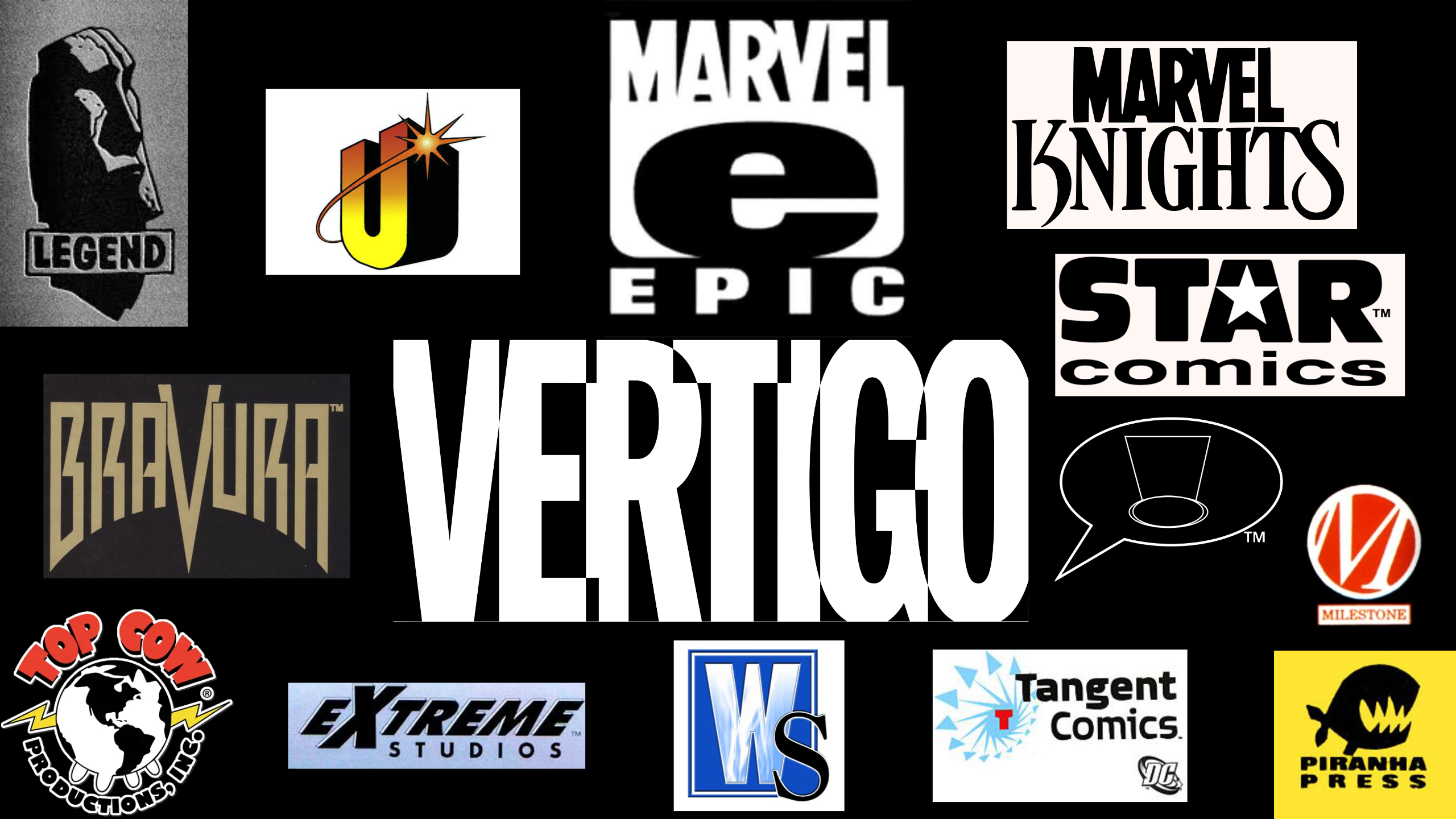
I went solo for this episode to talk about how the Dark Age of Comic Books, from the mid-1980s to 2000, was also the age of imprints, from Marvel’s Epic and Star to DC’s Vertigo and Milestone to Image’s Wildstorm and Extreme Studios.
One note: After I recorded, John pointed out that Marvel’s Midnight Sons line, which included Ghost Rider, Morbius, and others, was another important 90s Marvel imprint I should have mentioned. I’m sure there are others that deserved a mention, so let me know what else I missed.
John will be back next time as we finally discuss Ronin.
Subscribe to the podcast feed or find it on Spotify, Apple Podcasts, YouTube, or your favorite podcast app.
Credits:
Host: Klint Finley
Music: krudler.bandcamp.com
Rush transcript
Welcome to Sewer Mutant, the podcast for weirdos like you. I’m your host Klint Finley, flying solo for this episode. I wanted to talk about something I’ve been thinking about lately, which is how the dark age of comic books, that is the era from the mid-1980s until n- the 1990s, was also the age of imprints.
Let’s start with Epic, an imprint that Marvel established in 1982. It grew out of Epic Illustrated, which is a black-and-white magazine Marvel published from 1980 until 1986. Epic Illustrated was a Heavy Metal knockoff, but what’s important about it is that Marvel let the creators keep the copyrights for their work.
When Marvel expanded Epic into being an imprint, it also gave creators the opportunity to do creator-owned work for Marvel. This was important as the direct market, which we discussed in our episode on the death of Captain Marvel, had recently created the opportunity for new publishers to reach comic book stores without the logistical and financial burdens of dealing with newsstand distribution.
Eclipse and Pacific, and later First Comics, were attracting established creators like Don McGregor, P. Craig Russell, Jim Starlin, Steve Englehart, Jack Kirby, Mike Grell, Howard Chaykin, the list goes on. That motivated Marvel and DC to start publishing fully creator-owned works. Marvel started with Dreadstar by Jim Starlin under the Epic name. Epic helped win back Starlin and Englehart and created a space for mature readers titles. One particularly notable title was Moonshadow by J.M. DeMatteis and John J. Muth, which had a Vertigo aesthetic years before Vertigo was established. And Epic also housed other more mature titles like Elektra Lives Again, which was company-owned. Speaking of Vertigo, DC didn’t initially slot creator-owned work into an imprint.
The company started publishing creator-owned books, starting with Ronin by Frank Miller in 1982. But books like Ronin, The Naz, Breathtaker, The Psycho, all just carried the DC Comics logo. That said, they did eventually establish Piranha Press in 1989, which published The Epicurus: The Sage by William Messner-Loebs and Sam Kieth, and Gregory by Mark Hempel.
I’m not sure why things like The Naz and Breathtaker weren’t part of Piranha Press. Marvel also established the Star imprint for kids comics and licensed comics in 1984. It published titles like Care Bears, He-Man, and the first comic I ever read, Thundercats. Marvel’s New Universe line launched in 1986 to introduce a whole new line of titles set in a different continuity.
In 1991, DC launched Impact Comics, an imprint that featured Archie superhero characters like The Shield, Black Hood, and The Fly, all set in a separate continuity from the main line DC Universe.
But things really kicked into high gear for imprints in the 1990s with the birth of Image Comics and the launch of Vertigo. image sort of started out as an imprint of Malibu in 1992. I say sort of because the Image founders explicitly said Image was not an imprint of Malibu, but from a reader’s perspective, it appeared to be an imprint.
At any rate, Image spun off pretty quickly into its own company with each founding partner essentially running their own imprint. Although Jim Lee and Marc Silvestri quickly started using the names Aegis Entertainment and Top Cow as copyright holders for their work, I think the first Image partner to start explicitly grouping their books under an imprint was Rob Liefeld with Extreme Studios.
The Extreme logo first appears, as far as I can tell, in the inside covers of the books dated July 1993. So it was the Brigade ongoing series issue one, Bloodstrike issue two, and Supreme issue four. Then the logo begins appearing on cover starting in October of 1993. Lee changed his imprint name to Wildstorm in late 1993.
Over at DC, the company finally formally grouped a number of titles into a cohesive line, Vertigo, helmed by Karen Berger. This initially included Sandman, Animal Man, Swamp Thing, Shade, the Changing Man, Sandman Mystery Theater, and others. This became possibly the most influential line of comics in that decade.
Also in 1993, DC launched the Milestone imprint, led by Dwayne McDuffie and a number of other Black comic book creators, including Dennis Cowan, Michael T. Davis, Derek T. Dingle. This was an entire line of Black superhero comics and lasted until 1997, but has continued in various forms ever since, including the Static Shock animated series.
After Image fully separated from Malibu in early 1993, Malibu launched two new imprints, the Ultraverse and Bravura. The history of Malibu and its various earlier imprints/acquisitions/sister companies is beyond the scope of this podcast episode, so let’s just look at those two.
Ultraverse launched in June 1993. It was a company-owned shared superhero universe with titles like Prime, drawn by Norm Breyfogle, Rune by Barry Windsor-Smith, and Sludge, co-created by Steve Gerber. Bravura launched in January of 1994, and it was a creator-owned imprint that featured works by Walt Simonson, Jim Starlin, Howard Chaykin, Gil Kane, Dan Jurgens, and others.
Dark Horse, meanwhile, was launching a s- some similar initiatives, Comics’ Greatest World and Legends. Comics’ Greatest World, like Ultraverse, was a company-owned shared universe. X and Ghost are the most famous and long-lasting of these books. Legends, launched in late 1993, was like Bravura in that it was an imprint for prominent creators, generally more prominent at the time than those from Bravura.
The lineup included Frank Miller, John Byrne, Mike Mignola, Mike Allred, and Art Adams. It was a mix of both newer and more established names. Simonson later joined Legends as well.
Okay, back to Marvel. In 1993, Marvel launched Razorline, which was an imprint for Clive Barker and featured a whole line of characters that he created. There was also 2099, which of course featured characters in the far future date of 2099.
In 1995, Marvel had multiple editors-in-chief, and that involved creating new imprints, including Marvel Heroes for the Avengers-related titles, and Marvel Edge for titles like Punisher and Ghost Rider.
This arrangement lasted until 1996 when the new imprints, as well as Epic, shuttered. That was soon followed, however, by Heroes Reborn, where Marvel essentially outsourced the production of Captain America, Avengers, Iron Man, and the Fantastic Four to Rob Liefeld and Jim Lee. This wasn’t exactly an imprint, and the titles didn’t carry a distinct logo on the cover, but everyone knew they were part of a distinct line within Marvel.
After Heroes Reborn wound down, Marvel launched a new imprint helmed by Joe Quesada and Jimmy Palmiotti, called Marvel Knights, where they relaunched Daredevil, Black Panther, and other titles.
Quesada, of course, would later become editor-in-chief of the entirety of Marvel. DC, meanwhile, continued its own experiments and imprints. They essentially replaced Piranha with Paradox in 1994, and launched Helix for science fiction comics in 1996. Both of those eventually merged into the Vertigo imprint, which expanded from being a really cohesive line into a more general creator-owned line.
In 1997, DC also launched Tangent, a complete re-imagining of the DC Universe led by Dan Jurgens, and featuring contributions from creators like Mark Miller, Jackson Guice, John Ostrander, James Robinson, J.H. Williams III, Ron Marz, and Kurt Busiek. The lineup predated Marvel’s Ultimate Universe by a few years, but is probably more similar to the Absolute Universe and how radically it departs from the traditional DC Universe So this was a line that I didn’t remember at all having ever existed, and I never read any of those comics.
So let me know if those are of interest to anyone. After DC’s a- acquisition of WildStorm in 1998, WildStorm became an imprint of DC, along with the sub-imprints Cliffhanger, Homage, and Alan Moore’s America’s Best Comics.
The establishment of Epic helped kick off the Dark Age, so it’s appropriate that it was another Marvel imprint that helped end it. In my view, the Ultimate line, which started with Ultimate Spider-Man and Ultimate X-Men, launched the next era of comics after the Dark Age. I’ve been calling this the Mercurial Age. It’s also known as the Plastic Age. There’s a few other names for it out there.
Grant Morrison calls it the Renaissance. Imprints continued to be a thing during the age that followed, whatever you want to call that age. Marvel had the Ultimate line, it had Max, and later Icon.
DC had CMX, Minx, All Star, and another stab at the Archie characters with Red Circle. They went a little wild with imprints in the 2010s with Black Label, DC Ink, DC Zoom, Young Animal, and they eventually shuttered the Vertigo line and pared everything back down to DC Kids, which was for young readers, Black Label for adults, and everything else just fell under the regular DC label Image continued to be segmented by partner imprints and sub-imprints, and newer companies like IDW and Boom entered the field.
They too created and shuttered various imprints. But it’s really only in the past couple of years, to my mind at least, that imprints have become more prominent than they have been in many years. There’s the Energon Universe, the new Ultimate line, Absolute, Vertigo just came back. Tiny Onion is an imprint that spans across multiple publishers.
Mark Miller and Brian Michael Bendis both have their own imprints at Dark Horse. And I think this returns to the idea of creating a distinct line of comics with shared aesthetics, not just grouping things together by age range or by the fact that they happen to be creator-owned. What was great about those early Vertigo titles is you kinda knew if you liked one Vertigo book, you would like the others.
As the line expanded, that just stopped being true. The jury’s still out of the new Vertigo line, but I think it’s true of the Absolute, Energon, and Tiny Onion imprints that if you’re interested in one book from one of those lines, you’re gonna be interested in some of the others at least.
It’s, I think, another way that the Dark Age mirrors our contemporary age now. Anyway, I’m gonna wrap it up there. Our music is by Krudler. You can find more of his stuff at Krudler.bandcamp.com. Please let me know if there’s titles you want us to read and discuss on the podcast.
Let me know what you think of the episodes that we’ve done so far. Just yeah talk to us. We’d love to hear from you.
📍