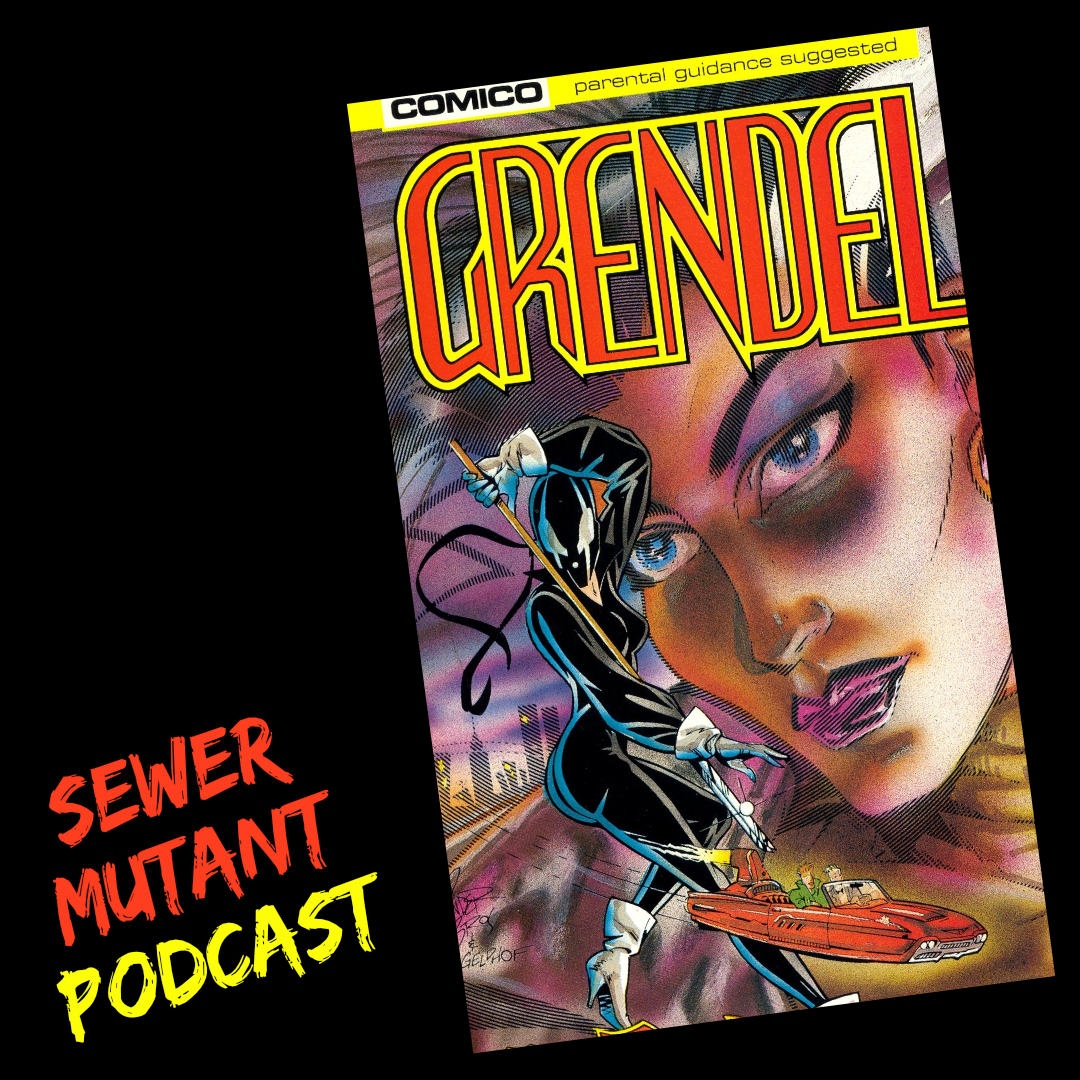
In our second installment on Matt Wagner’s Grendel, we dive into issues 1-20 of the ongoing series from Comico, as well as the Grendel: Devil’s Vagary one shot. We begin with the second Grendel Christine Spar, continue to Brian Li Sung, and wrap-up with Captain Wiggins. We talk about the Pander Brothers, how 1986 is the most 80s year of the 80s, Wagner’s experiments, and more.
Also: The Sewer Mutant print zine is coming! The theme is cyberpunk. I’m working on an article on OMAC and Deathlok. John’s working on articles on Death’s Head and John Bergin’s Golgothika. And we might do a tie-in episode on Machine Man. If you’d like to contribute an article, artwork, or short comic, email me pitches at klintfinley at gmail.com. The deadline will be August 15th, with a goal of publishing this fall.
Subscribe to the podcast feed or find it on Spotify, Apple Podcasts, YouTube, or your favorite podcast app.
Credits:
Hosts: Klint Finley and John Ekleberry
Music: krudler.bandcamp.com
Mentioned in this episode:
Berserker issue 1 from Gauntlet Comics by Gary Carlson.
The Megaton comic I’m talking about is Megaton Holiday Special (1993) from Entity.
Rush transcript:
Klint Finley (00:13)
Welcome to Sewer Mutant, the comic book podcast for Weirdos Like You. Our theme music is by Krudler and you can find more of his work at crudler.bandcamp.com. I’m your host, Finley, and I’m joined as always by my co-host, John Eckleberry. How are you today, John?
John (00:27)
I’m great. I’m excited to talk about more Grendel.
Klint Finley (00:30)
I bet, yeah. So today, like John said, we’re continuing our history of the Dark Age of comic books by diving into issues one through 20 of Matt Wagner’s Grindel series, which is actually our first foray into covering something that is unambiguously part of the Dark Age. And we’ll see some pretty radical changes in the comic over these 20 issues. Before we get into that, you may have already heard by the time this comes out that we’re doing the first Sewer Mutant print zine.
the cyberpunk special. I’m working on an article on both Jack Kirby’s OMAC and the original 1970s Deathlock series from Amazing Adventures. It’s going to be sort of a cyberpunk in the 1970s article. And I might do something on the Marvel UK series Warheads. And John, you’re working on a couple of things as well.
John (01:16)
Yeah, I’ve got some things spinning in my head. So you mentioned Warhead, so I might as well start with Marvel UK as well. Death’s Head was what came to mind for me. I really enjoy that character, both the original iteration and the later 90s iteration. So I’ll probably do an article about that. I also had talked about Machine Man, the limited series by Barry Windsor Smith and Herb Trimpy.
Then we had talked about maybe doing something on Golgothika, John Bergen’s Calibre comic. So those are all spinning around in my head. And then this morning when I was thinking about other cyberpunk stuff, I thought it might even be interesting to revisit Robocop versus The Terminator. That’s a fun little horror issue series that came out from Dark Horse in the 90s.
Klint Finley (01:59)
Yeah, with Walt Simonson, who we ⁓ talked about in the manhunter episode. Yeah, so now before we get back to Grendel we like to do a little icebreaker to get to know each other better and to help listeners get to know us a little bit better. John, you had a icebreaker question you wanted to ask this time.
John (02:15)
I do. don’t normally ask you comic book questions. I normally ask you non-comic questions because I want a broader view. But I thought this might be interesting given what we’re covering. What is the first black and white comic book you ever remember reading?
Klint Finley (02:29)
wow. So there’s a few things that were all kind of around the same time, but I think Frame 137 by James Obar in Dark Horse Presents might be the first one. It was either that or like an Ashcan comic from the Amateur Creators Union that I wrote about extensively on sewer mutant.com. So was one of those things probably.
How about you?
John (02:53)
The first one I remember vividly is a comic called Berserker that was written by Gary Carlson and had art by Angel Medina. It came out through Gauntlet Comics, which I didn’t realize until today was an imprint of Calibur. It spun out of Megaton earlier. Megaton had already gone out of business. And then Carlson hooked up with Gary Reid at Calibur and printed some comics with some of these characters again.
It was just a book that I got out of a dime bin and thought the cover was really cool. And I never got any of the other issues. I kind of like to now. I’ve got a Megaton archives graphic sitting on my desk here, but it’d be cool to check out the rest of those issues at some point.
Klint Finley (03:35)
Yeah, is he like green with like a mohawk and kind of a Roman gladiator?
John (03:38)
Yeah, yeah, green with
a purple mohawk. Glad either type character.
Klint Finley (03:42)
Okay, yeah, I’ve seen the character. don’t, you know, I don’t think I’ve read any ⁓ of his comics. I had like a Megaton special that came out like after Megaton was over. Like after they had gone out of business originally, I think they, after the image revolution, because they had done some, they were going to publish Rob Liefeld’s Youngblood originally. And I think the Savage, the first appearance of the Savage Dragon was in a Megaton comic. So.
They kind of reformed and did this Megaton special that had some stuff from that period and like pinups and stuff, I think. I don’t remember it too vividly, I think that’s my…
John (04:14)
is everything,
because I read from Gary Carlson in the back of this thing I have sitting on my desk that one of the things that he decided was kind of the nail in the coffin of his company was that Youngblood got less than a thousand pre-orders and so he’s just like, it’s over. I’m not going to get any orders. But it’s funny that, you know, less than five years later, Youngblood was the first million selling image comic.
I mean, certainly Rob Liefeld came to prominence in between those two times, but it’s interesting to see how those creators springboarded off of there, both Larsson and Liefeld.
Klint Finley (04:50)
Yeah. So to get back to Grendel, John, do you want to give us a quick overview of this episode’s reading?
John (04:57)
Yeah, we read issues one through 20 of the ongoing story. So what that amounts to is the first 12 issues cover the Christine Spar arc and then issues 13 through 15 cover ⁓ Brian’s story. And then Matt Wagner comes back and does some issues. He does four issues that featured Hunter Rose, which are told in unique ways that we’ll talk about. And then issue 20 is kind of a cap to this.
era of the comic. It discusses the character Wiggins and it has art by Hannibal King, which is probably the earliest art from him I’ve seen. I’m familiar with him from other stuff, but it was interesting to see him here. And I think he’s also inked by Tim Sale, which is, know, Tim Sale goes on to do some more art in this as well later on. And then there’s a one shot that we read, Devil’s Vagary, that was originally released as a one shot.
⁓ It came with a box set the Kameco Collection that had like a cool looking slip case with a Grendel’s face on the cover and the 16 issue ⁓ one shot and then it had a bunch of Kameco back issues it came with 10 random back issues to get people into the company And that’s kind of a neat thing. It also introduced the black white and red color scheme for the first time that we’ll see a lot later
But yeah, ⁓ the Panda Brothers on the Christine arc are great, so we’ll dive into that right now.
Klint Finley (06:18)
Yeah. And then if listeners haven’t read this yet, most of this is in the second Grendel omnibus volume. Devil’s Vagary is actually in the first volume because it was originally reprinted in black, white and red. And then it continues to be part of the black, white and red reprint in that first omnibus. And issue 20 is actually in the third omnibus. And we’ll talk a little bit about why that is ⁓ later, but the bulk of it is of what we’re talking about today.
is in that second volume, and we’re talking about pretty much everything that’s in that second volume except for Devil’s Child. So I mentioned last time that this Grindel series was a big departure from the comics business as usual at the time. So we saw Matt Wagner come out the gate in issue number one, gender-swapping the main character. I mean, there weren’t a ton of female characters in this time period to begin with, let alone
taking a male character and replacing him with a female character was not something that you saw a ton of at that time. I’m not sure if it was the first or not, but it was an early example for sure. And then this whole idea of introducing a new art team for each storyline is another thing that if it had ever been done before, it was super uncommon. And I’m not sure it had been done before at all.
So this series starts in 1986, which is just peak 80s. This is the year of Top Gun, Crocodile Dundee, Ferris Bueller’s Day Off, Aliens, the death of Optimus Prime, Madonna, Berlin, Bon Jovi, the Human League, the Pet Shop Boys, they were all over the charts. Metallica released Master of Puppets that year. Watchmen and Dark Knight Returns began. The Chernobyl disaster happened. The Challenger explosion happened.
Haley’s Comet was visible from the earth. It’s like the entire eighties happening in just one year. Like it’s the most eighties year of the eighties, I would say. And so into this like just crazy stew of culture and disaster comes Grendel number one with the Pander brothers who are just the most eighties artists that one could imagine. So a lot of people, think, just bounce off of this one, especially given the contrast.
from what came before, especially if you’re reading the omnibuses and you’ve gone through all of the latter day Hunter Rose stories that are, I think, a little bit more sophisticated. And then you kind of jump backwards in time to this storyline. I think it’s a little bit rough for people. I love it though. The cover reminds me of the cover of the Duran Duran album, Rio, by Patrick Nagel, who’s, this this style of like,
glamorous illustration that you see even today at like hair and nail salons will still have some of these artwork and illustrations by either by him or by people drawing like him. So it just really brings like this whole like pop glamour image to this title. And that contrasts a lot with the next story arc, which we’ll talk about. I think it kind of emphasizes some of the theme that’s happening here where
I think you could accuse Christine Spahr, who’s the new Grendel, and she’s the daughter of Hunter Rose’s, the original Grendel’s adopted daughter. So she’s like the granddaughter of Grendel. She’s written this book, Devil by the Deed, and that appears in a comic book form as essentially a comic book adaptation of this fictional book that she wrote. And she could be essentially accused of glamorizing Hunter Rose, I think, that…
He’s kind of this figure at this point, almost like Scarface or Hal Capone or something, like this gangster essentially, who’s larger than life, that people are kind of obsessed with and interested in. And, but also just, you know, a horrible, violent person that shouldn’t really be anyone’s role model. And, you know, as, as usual, I think the original color is better than the one in the
color that we find in the reprints. But I think the brighter colors match their style better and kind of hits this mark of this is this hyper saturated, hyper 80s pop world with huge haircuts, bright colors. I don’t know. So what did you think going from those earlier arcs into this?
John (10:24)
I loved it. was just, I was blowing through these pretty quickly and I was super into it. It’s an intro. It’s, it’s a weird like an anachronism that it looks so eighties, but it takes place in the future. And so it’s like their idea of the future, but in the eighties. And I just love the, the angular kind of Art Deco style. It kind of reminded me of, yeah, in flux a little bit. wonder if there was a, influence somewhere there.
This is the first time I’d ever seen the Panda Brothers art in anything, and I just took to it really quickly. And I like the parallels of, you know, Grendel himself, Hunter Rose, had to have this weird, like, werewolf antagonist. And Christine has her own. She has this weird cat vampire guy, Tujiro, that’s this crazy, strange, mystical…
⁓ antagonists that she ends up going up against. And, ⁓ you know, the first two thirds of the story is, is involved with, with her fighting this guy and tracking this guy. And then, ⁓ she just kind of abandons that I don’t know if the idea is that the Grendel persona is like, you know, permeated here so deeply that now, Grendel’s enemies become her enemy. She, she wants to go after Argent because she wants to finish what the original Grendel started.
And so then the end of the story is more about that. But yeah, just like the original, there’s just some crazy stuff going on. Like this is clearly a little bit off kilter world. It’s not really, it’s definitely not the real world. It’s a fantastical world, but still grounded for the most part.
Klint Finley (11:53)
Yeah, I mean, it’s interesting because it’s the future, but there’s almost no reason for it to be the future other than that. I think it had to be because Wagner wanted to do this time jump to explore Christine and he hadn’t set the originals in the past. So he had to make it the future to have her be an adult. So there’s like there’s flying cars, but there’s not it’s not really very interested in being science fiction. You know, it’s it’s really is mostly just
John (12:11)
Right.
Klint Finley (12:20)
the 80s, but there’s flying cars, flying landlines, because no one’s got cell phones. There’s still phone booths. I think flying or floating televisions, it’s just this very like kind of like just shorthand for this is the future. Not that much has changed, but there are some hints of things that are that are going to happen later. People keep complaining about taxi drivers. They use
a racial slur that I think, I mean, a lot of people even today don’t realize is a racial slur, but especially in the eighties, the word Eskimo refers to generally to Inuit people, the native peoples of Alaska. And for some reason, there’s a ton of them in both New York and San Francisco. And I don’t know if Wagner had already decided why that was, but we’ll find out later.
why there’s so much immigration from Northern Canada and Alaska at this point in time. And then the other thing is that if you notice, Christine’s conflict is not with the ⁓ New York Police Department. It is with an organization called C.O.P, COP. And ⁓ that’s another thing that I don’t know if Wagner was really… ⁓
thinking much about that at this point, or if he was just like, it’s going to be like a corporate police force or something, which we see again in RoboCop. But this is like a year before RoboCop came out. But that does become important later as well. But I don’t know if he was planning ahead or if those are just details he threw in and then built on at a later point.
John (13:50)
It kind of reminds me of the, know, whenever they’re trying to predict the future, sometimes they get some things right and some things wrong. Like there’s these like floating telephones, but they’re like giant car phones, like from the eighties that, know, are floating in it. It reminds me of in Star Trek, the next generation, they have tablets, but they didn’t predict the internet. So they have like a pile of tablets on their desk and they look at, you know, they exchanged them. They didn’t think, I only need one because it’s going to have.
You know, all the information on it. It’s cool. I really enjoy all this stuff. The very first page of issue one sets it up with a throwaway line because she mentioned something about Phil Donahue and she’s like, what is he like 70 now? And he’s at the time would have been like 50 or something. So you’re like, okay, this is like 20 years in the future. Like I got it. We’re all set up.
Klint Finley (14:38)
Yeah. I think some people have actually tried to do the math on this and there’s ref that it’s supposed to be 2026. I think that adds up correctly. So he would have actually been a lot more than 70 and ⁓ he died last year, didn’t he?
John (14:53)
Yeah, recently. So they think it’s further in the future than that. That’s interesting, which I guess makes sense because she’s the granddaughter. I mean, I guess I’d have to read the… You’ve read Devil’s Child. I haven’t read Devil’s Child yet because it’s not published till later tonight. This story is a good reason to read things in publication order because like you said, if you read all that later stuff and then you kind of come back to this, it’s jarring. But I was just blasting through in publication order. And I thought that this was all super cool.
Klint Finley (15:00)
Yeah.
Yeah, yeah, I think it’s, it’s not just that, um, yeah, she’s the granddaughter, but she has her own kid. That’s kind of the whole plot, uh, hook is that her kid gets kidnapped by two zero and he’s looks like he’s probably about 10. So, you know, she’s old enough, you know, to have a 10 year old son, um, from, and so yeah, it’s decades after the original for sure.
And that something else that I made a note of here is that she, so she has a love interest in this Brian Leesong who is in the next story arc. She says that she’s older than him. She says something about like, I’d never been with somebody younger. And that kind of sparked this, whole thing about Jocasta and Hunter Rose and the age gap there.
It’s unclear how big this age gap is between Brian and Christine, but I think Christine’s probably in her mid thirties, which makes all her athleticism, you know, all the more impressive. and then Brian, I mean, he’s got to be in his mid twenties if he’s got kind of the job that he’s got, unless it’s, you know, just pure nepotism that they would just put an 18 year old kid in charge of, ⁓ stage managing like a big fancy theater. But so I’m thinking it’s, you know, probably.
35 and 25, so not as big and consequential a gap as Jocasta and Hunter, but it’s interesting that that comes up again in that relationship. And I guess there’s kind of more important, more importantly than that age gap is like there’s an innocence gap where Brian is just really innocent compared to Christine at this point who has become possessed by Grendel and lost her son and…
on this revenge quest. I don’t know. just, initially parallel between her and Hunter there, I guess.
John (17:07)
Well, and the idea that her son is like abducted and murdered like pretty brutally is awful. Like they don’t show it, but as your, as your wheels are spinning and you’re thinking about it, as the story’s going on, you’re like, wow, this is really terrible. And they actually allow you to believe for a little bit that like, maybe he could still be alive. And then, you know, she discovers these, these body parts, basically she discovers these eyeballs and I don’t know if she.
recognizes that one of them actually is her son’s. She looks into the eye and she can tell that it’s his eye or not. Because they never really resolve that. Like she never finds a body. She never, you know, follows up on that because she kind of goes off on her tangent after she kills all of Tijiro’s guys. But it’s pretty grisly, like if you really think about it.
Klint Finley (17:50)
Yeah.
Yeah. And if you look at like the house ads for it at the time, it was described as a horror comic, which I think is kind of interesting because it really reads more like this action superhero comic, but with these horror elements. And I guess that kind of speaks to the 1986 comic book context where mature readers comics were still pretty new.
Apart from like the underground scene, the original late 60s, early 70s undergrounds. This is maybe one of the first comics to actually carry that suggested for mature readers label on it. I’m not sure about that. Come to think of it. yeah, it has this like bright poppy look to it, but it’s actually quite dark what’s happening in the stories. yeah, that was…
kind of what I took away too is that she recognized Anson’s eye and assumed that he was dead. it’s, like you said, to me, it’s a little, it is strange that she abandons the hunt for Tajiro after he escapes. I mean, to be fair to her, would be, what happens to him, it would be very difficult for her to find him again. And she has completely destroyed his organization. And she’s…
feeling a lot of heat from the San Francisco police and returns to New York. But yeah, I think it is, there’s an element of it being that she’s being guided by Grendel and Grendel doesn’t care that much about Tujiro, but Grendel cares a lot about Argent. And that’s why she goes so A-cab in New York and starts killing cops and goes after Argent.
John (19:24)
Which I guess brings us to the silent issue if we want to talk about that. You know, it’s funny because I was like blazing through these issues. I was reading super fast. It’s really enjoying them. And I hit the silent issue and I hated it. I was like, was like, this sucks. Like I would be so mad if I was reading this month to month on the stands and I got that and I, you know, read it in five minutes and then I had to wait another month for the next comic.
I did reread it this morning and I guess I didn’t hate it as much as I hated it when I was doing my initial read through. But it definitely stopped me in my tracks when I was, you know, on a quest to read the whole thing. It’s funny, it’s the second silent issue that we’ve covered on the podcast because there was a silent issue for Manhunter also. And I think that one was maybe better than this. If I try to think back on silent issues, there’s a really good Punisher silent issue.
that Steve Dillon did. I think that’s probably my favorite silent comic that I’ve read, but it’s definitely a gimmick that we’ve seen before, but maybe not in 1986. I mean, maybe it was pretty revolutionary at that point. I don’t know.
Klint Finley (20:25)
I think it was unusual. I had meant to look up whether the Larry Hammett, G.I. Joe silent issue was before or after this. I think it may have been a little bit before, but it was, you know, it was still pretty novel of an idea. I liked it. I felt like it was a good change of pace. You make a good point about if you were getting this month to month, how would you feel about, you know, really wanting to know what’s going to happen and then like…
This whole issue is kind of just one thing happening very slowly in the silent format. I think it was, you know, I thought it was good, but I think though that kind of speaks more to my larger issue with this is that it’s just too long for the amount of story that actually unfolds in it. Like the whole 12 issue arc. And it’s the longest Grindel story arc up until Behold the Devil in 2007. You know, how long is…
Devil by the Deed, like 48 pages or something that condenses like the entire history of Hunter Rose. And then we get just, you know, a couple of weeks of Christine’s life spread out over, over 12 issues. It’s very decompressed and, you know, that’s fine, I guess, but it seems in contrast to everything else, like so, so big and probably unnecessarily so with kind of, you know, essentially two story arcs within it, like
the Tujero story arc and then the New York Argent story arc.
John (21:44)
Well, if you contrast it with what comes after it, all of those arcs are only like two or three issues a piece, or even like one issue in the case of the last one. I just looked up the GI Joe issue. was GI Joe 21 from 1984. So that did precede this, but only by a couple of years.
Klint Finley (21:49)
Yeah.
According to the letters column, it was actually really successful with readers. Most readers really liked the silent issue. So I guess, yeah, they were buying it month to month and they got into it. So should we move on to the Brian Lee Sung storyline?
John (22:17)
Yeah, yeah. So, well, of course, the Christine arc ends in tragedy, like every Grendel story ends in tragedy. But beyond the tragedy, just for her, Brian now has descended into this. He starts to descend into the same madness that she does. He has Hunter’s journals and he starts to read them. And you had mentioned the contrast of, you know, he’s working at ⁓ a big, beautiful, nice theater, you know, like out in L.A. or whatever, San Francisco.
And then he comes to New York and suddenly everything is like really dreary for him.
Klint Finley (22:49)
Yeah. Yeah. mean, so this is, it’s a difficult read both because of the subject matter. And then this is told with like three parallel tracks on each page. Essentially there’s journal entries from Brian. There’s the conventional panel to panel comic book story. And then there’s these additional, uh, rants at the bottom of each page that we find out is, is Grendel and that they’re like,
on the backs of pages of Brian’s journals that he didn’t realize he was writing or something. So you have to kind of like read these three different things on each page and they counterpoint each other at times, but it makes like the flow kind of difficult and I think intentionally so. But that’s a really hard pivot from how conventional the
Christine’s Spar Story arc was, but this probably reflects a little bit of, again, the time that it was published. This is the first Grindel arc that’s like fully post Watchmen, fully post Dark Knight Returns. The Christine stuff was essentially concurrent with Watchmen’s release, and the original stuff was essentially concurrent with Warrior’s release, but…
This is, like I said at the top, we’re now like fully in the dark age and we’re starting to get the knock on effects of what Alan Moore was doing with like the Rorschach’s journal and the big text pieces in Watchmen. I think, I think some of that was probably actually influenced by Wagner’s Devil by the Deed, his interest in doing some of the text stuff in Watchmen. But now Wagner is picking up, you know, the
the influence from Moore. it’s interesting to see that influence seeming to go both directions, I think. But so we get some pretty challenging storytelling here. then, yeah, like I said, like the first arc, the Christine arc is all about the glamour. And then, yeah, it’s real gritty when Brian gets his story arc. And I was kind of thinking about how that also just reflects like
changes in his life in San Francisco, like you were saying, he was running, you know, a big important theater company or something. And then, you know, he has a nice apartment there with a floating television and everything. And then he comes to New York, follows Christine out to New York. Well, and the other thing in the Christine arc, like he fights some of Tujiro’s goons, like he’s does Tai Chi and was able to up
Apparently apply it pretty well. He’s like handsome, athletic. They make a, like we were talking about, Christine makes a point of saying how young he is. So he’s, but then he comes to New York and he’s just like immediately emasculated. He gets beat up by a cop that followed him there from San Francisco. He’s trying to talk Christine out of going on this crazy quest and she goes out and does it anyway. He shows up to the battle, her final battle with Argent, like too late to have any influence on it.
So he’s just, you can kind of just see him just being taken down peg by peg. And then, yeah, he’s at this old rundown theater. It kind of implies that it’s like somewhat a prestigious theater, but it’s just not, it doesn’t seem like it’s what he was used to in San Francisco. He gets mistreated a lot. There’s people, he’s a Chinese American. There’s people being racist against him. He lives in a crummy apartment. People keep…
accusing him of being gay, including ⁓ Wiggins, the cop that was kind of Argent’s right-hand man in the previous storyline. So it kind of reminds me of falling down the movie of just, he’s just kind of put upon and put upon and put upon until he finally snaps.
John (26:21)
Yeah, and I I like the idea that when the so it you mentioned that it’s kind of hard to read to I actually Switched modes in the middle of it like I was trying to read it like top to bottom You know like a traditional comic and then I kind of realized that I had to pick and so I would read like all the journal entries and then I would read all of the panels and Then I would read you know the Grendel stuff at the top and the bottom But when you look at the the Christine Spar arc that’s actually kind of
Klint Finley (26:21)
on.
John (26:47)
It’s so straightforward, but you know, the rest of the stuff that Wagner writes isn’t because the original Devil by the Deed is told in an interesting way and this arc is, and so are the arcs that follows it. You know, he tries with each arc to do something very different. And maybe he just told the Christine arc in this way to cater to the artists, you know, the big bombastic style that they had. But in this arc, it’s interesting to me that like,
Christine not only took over for Grendel, but she had Grendel’s actual stuff. Like she had Grendel’s actual mask and his actual fork. She went and stole that stuff. And so she had his actual props, but Brian’s just kind of like descending into madness and he just like makes his own mask. And you know, that’s the first time we kind of see Grendel like reconstitute, I guess himself in somebody else. You know, he’s not leaning on the same props, but.
but he still has the same motif. But it’s that homemade kind of look where he has like all the cool stitching like around the mask and he goes and gets like a bow and arrow from somewhere and just like, starts killing homeless people. Like it’s pretty wild.
Klint Finley (27:54)
Yeah, and that also underscores that contrast where Christine’s outfit was like, it seemed very professional, know, like very like a, like she knew what she was doing. And then Brian’s just like real, like you said, it looks cool with the stitching, it’s like, it’s clear like with this homemade thing that, you know, if he was going to a Comic-Con doing cosplay, like people would probably
Like, kind of look at him like, you’re not doing Grendel right, bro. Look at this lady. Like, that’s a Grendel costume right there. add some further contrast to that previous arc. I think, yeah, come to think of it, this is the first time where we get the idea of Grendel as an entity. And ⁓ in those, the…
Grindel written notes at the bottoms of the pages, he refers to Brian as his host. So that’s kind of, that’s noteworthy, I think, in this arc.
John (28:46)
And Grendel kind of has, you know, diminishing returns with these hosts because even though he, he’s kind of pushing them towards a tragic end, like he pushes Brian to a point where, you know, Brian goes down like at the end in kind of a somewhat easy and shocking way, you know, when Wiggins catches up with him. and then that’s kind of it. Although we see later that, you know, Grendel presumably moves on to Wiggins himself.
Klint Finley (29:10)
Yeah, and you mentioned that Christine had ⁓ Hunter Rose’s stuff. It seems like one thing that Brian does have is the original journals that Christine left to him, both her journals and Hunter’s journals. And it reinforces that notion of the way Grindel spreads is through reading, which I guess is a fun thing for a comic book.
that you’ve kind of seems like it’s happening to you there, John. You’ve been getting obsessed with Grendel.
John (29:38)
I seriously,
I felt like possessed to read it. We were in the middle of reading Ronin and I was just like, you know what? No, I’m going to read Grendel. And then I blasted through like, you know, the first, the original stuff and the first 20 issues of this. And I’m pretty excited to get back to it and read more because I haven’t read beyond that yet.
Klint Finley (29:41)
Yeah.
Yeah. Buying statues and, how many Grendel?
John (29:57)
all the
stuff. I’ve gone down the rabbit hole. I bought the original figures. I can’t remember the company now that put them out, but there’s a Grendel and there’s also a Christine. And then Dark Horse put out like a seven PVC figures that has all the different Grendels. I picked that up. then yesterday I ordered another Grendel figure from this long box collection that’s designed in the kind of superpowers scale.
Klint Finley (30:00)
Yeah.
man.
John (30:23)
And I’ll probably stop there. That’s probably it. And I also just bought a bunch of Grendelback issues so that I can continue to read these in paper instead of having to read them digitally.
Klint Finley (30:34)
But you’re not usually like much of a toy and statue guy. Like this is unusual behavior for you.
John (30:41)
I have a rule that I don’t buy those things because I don’t have anywhere to put them. But sometimes I break that rule and I broke it for Grendel. So now my desk is covered in Grendel memorabilia.
Klint Finley (30:52)
How many Grendel tattoos do you have?
John (30:54)
⁓ thankfully none. No tattoos of any kind. I suppose if I was gonna get a tattoo ever, it would be a crow tattoo, but I’m never gonna get a tattoo. I’m not a tattoo guy.
Klint Finley (31:03)
So yeah, I’ll know if something’s gone really wrong if our next call, you’ve got like the grindle eyes tattooed on your face that. ⁓
John (31:11)
Maybe
I’ll be wearing a mask next time. You know, I’ll knit myself my own Grendel mask.
Klint Finley (31:13)
Yeah.
There we go. Yeah. So we’ll talk a little bit. We can talk some about the creators on this one. So the artist on this arc is Bernie Miro, Canadian artist who is known for some other things. The Jam needed a Riddler story in Secret Origins ⁓ with Neil Gaiman. But ⁓
Yeah, stylistically, it’s such a different contrast from the Panders. Like this was actually for me on my original read through, I didn’t like the art very much because I think I had gotten so accustomed to that, you know, the Pander Brothers bombast. And then like years later I read The Jam and it was just like this huge breath of fresh air for me coming from all these gruesome outlaw comics that I’d been reading.
The Jam is this character who’s like, actually like a really nice guy, like the kind of guy you’d want to hang out with and be friends with in real life, as opposed to somebody like Faust or a lot of these other characters who you wouldn’t want to be in the same room with ever. I appreciated his art a lot more this time through, become more familiar with his style and being a little bit more ready for just how…
hard the tonal shift was going to be. Miro took his own life in 2024. So this is my first time revisiting his work since then. I think that the grim nature of this story is kind of fitting with the somber tragic end of his own life. I really want to recommend The Jam to people, but I haven’t been able to go back and look at it because it’s such a happy book compared to what…
ended up happening in his life. And then also rather sad that there was a new colorist that joined in this one, Joe Matt, who did an autobiographical comic called Peep Show that I read in my 20s. has a bunch of comic book creators as characters in it, including Seth, who did Clyde’s fans. But…
Matt died of a heart attack in 2023 at the age of 60. And I think you had some other information on him.
John (33:17)
⁓ just that he went to school with Matt Wagner and so they were friends and he brought him in on this and he ended up coloring a bunch of issues of Grendel and Miro also colored some of the stuff later. Miro had actually written Wagner about Mage and Wagner talks about this in the introduction that’s in issue 13 that
Miro was a little bit critical of him at first, but then he kind of realized what he was doing and they kind of hit it off and became friends. And they said, okay, well, why don’t you come, you know, come work on this? And by the end of it, Wagner said that it was his most pleasant collaboration up until that point. So they really enjoyed working together.
Klint Finley (33:52)
Yeah, I’m trying to remember the name of that of the comic that he did before the jam That’s that’s one that I haven’t read yet that i’m looking forward to To digging into at some point. mckenzie queen
John (34:04)
Matrix graphics, whatever company that was. I haven’t seen anything by them, I don’t think.
Klint Finley (34:04)
So yeah. ⁓
Yeah, they also published The Jam and maybe a couple of other things, but they were a Canadian company around that same time. So we can move on perhaps to another Canadian connection here with ⁓ The Devil’s Vagary. So that’s the one you were talking about that was originally part of that boxed set. So this was, I had never read this before. ⁓ I thought I was a real Grendel head, but I didn’t even know about it. ⁓
So ⁓ I got a copy. It’s not my favorite Grendel story, but I’m glad to have it. And it was the first return to Hunter Rose by Matt Wagner. And like you said, it introduces the black, white, and red color scheme. So I was kind of surprised to see that so early too. I didn’t think he’d started that until the 90s, but it goes all the way back to that.
So the Canadian connection is Dean Motter, who was the artist of this book. He’s best known for Mr. X from Vortex Comics, another Canadian publisher. And the early issues of those were drawn by Los Brothers Hernandez of Love and Rockets fame. And it really set a new bar for like the graphic design of comic books. He did really interesting covers and
Dean Mutter was a graphic designer, or is also a graphic designer. I think did like record album inserts and stuff like that. So I really brought like a different look to doing comics at that time period. think the Grindel is also, I think, very graphically interesting in those, in that way. So I think that they’re, they’re kind of two peas in a pod.
John (35:39)
It’s interesting to see how many of these indie guys flip between writing and art and can do both. mean, maybe some of that’s out of necessity, right? Like if you can do the art and maybe you don’t have a writer, maybe you just need to figure out how to do that part yourself too. Modder is kind of interesting. I think the thing that I know him best from is he did a prisoner mini-series for DC Comics based on the Cult TV show.
And I think that was my first introduction to his stuff, but I’d be excited to read more. know, we could read Mr. X or we could read read something else. I think Devil’s Vagary slots in pretty well with the other two Hunter Rose stories that come after the Brian arc. Wagner comes back and does two, two issue stories.
can’t remember the names of either. I think one’s called Devil’s Tracks and the other one called Devil’s Eyes. I don’t even know that they were titled in the issues, but they did give them titles when they put them in trade paperback. That first one, Devil’s Tracks, I really enjoyed. It’s like 25 panel grids on every single page, these tiny little panels, and it’s told kind of like a, almost like a comic strip rather than,
you know, a traditional regular page to page sequential comic. And I thought that was pretty neat. It was about this detective that investigates Grendel or well, he doesn’t even know he’s investigating Grendel at first. He’s just investigating like this diamond ring or whatever. And he just gets deeper and deeper and deeper. then, you know, of course, the end is tragic because all of these stories are. But he just he finally realizes that, no, I’m like,
I’m investigating Grendel. This is bad. I probably shouldn’t be doing this, but it’s too late by the time he gets that far down the rabbit hole. And then the story right after that is about ⁓ Grendel tracking down and killing an informant. And it’s great because during the whole story, this informant’s super paranoid that Grendel’s gonna comfort him, but Grendel’s just forgotten about him. He doesn’t even care. And so this guy’s like…
living his life in like real paranoia, like he gets to the point where he like won’t leave his apartment. He, you know, he’s barricading himself in and he won’t like even go, go out and he sets all these traps and he sets a trap on the fire escape and he does all this stuff and like, Grendel at some point in the story is like, yeah, I was going to go kill that guy. I guess I should go do that. And then they have their, you know, their face off at the end, but, they were both pretty good.
And they both showcase different ways of telling the stories. The one had the 25 panel grids. The second one had, I think it’s four long panels per page. And then it had descriptions on the top that you would almost be descriptions for the artist, but they left them on there so the reader can see what’s supposed to be in the panel. And then we see the panel drawn. And then below that has text explaining. It’s pretty cool. It’s a neat format.
And it’s a neat exercise. seems like Wagner was always trying to reinvent how he was doing these things every time he came back to it.
Klint Finley (38:32)
Yeah, I think these are a lot more successful experiments than the previous two big experimental things with Devil by the Deed and the Brian Lee song story. These are similar to Devil by the Deed in that there’s no word balloons, I don’t think. It’s all kind of illustrations with pros, with captions. But the…
Art is more integrated into the story, think, this time. So they actually are unambiguously comics where even Alan Moore was kind of questioning, like, where does illustrated prose end in comics begin with Devil by the Deed? And my take was someplace before Devil by the Deed. I think Devil by the Deed is just illustrated prose. These are definitely comics.
even though I’m not really seeing anyone else do replicate these experiments, they’re a lot more successful. They’re less challenging technically to read than the Brian Lee song stories as well. think they flow a little bit easier. The only kind of difficult thing were those things you were talking about, the notes at the top of the other story.
And so I read something that was a reference there that those are okay. So let’s back up for one second The frame for these is that they are Wiggins writing a book about Hunter Rose even though Wiggins Wasn’t around for Hunter Rose. He investigated Christine’s bar and Brian Lee song but he shows him like dictating a book while lounging on the beach and then the
the book is these stories are part of that book. so what I read was that those notes are Wiggins’ notes for the book, which I don’t know, it doesn’t quite compute to me. It does seem to me more like their Wagner’s script for the comic and you just decided to put them on there. But I don’t think that was, I think that was maybe a failed part of this.
of this particular experiment, in my opinion. But I think both of those stories are really good. They fill in some gap, or they kind of expand on some stuff that was in Endeveled by the Deed, particularly the incident where Argent falls through the skylight into a party. We find out the whole backstory for that in the informant story. And so that’s cool to see.
You know, so many issues of Not Hunter Rose. It was very nice to revisit Rose in this more expanded storytelling style than the hyper-compressed Devil by the Deed. And Wagner illustrated these himself, so we hadn’t seen him doing his own art in a while. So that was cool as well. Oh, I want to…
Back up again a little bit back to Joe Matt Set some of the only original color that’s retained in the omnibus editions is Joe Matt’s color work Most of the work in the in the omnibuses has been recolored, but for whatever reason They decided to keep the original color for those ones by by Joe Matt, which I Keep saying like we keep the original color. So they made the right call
At least that time.
John (41:35)
I can understand why they recolored the Christine arc for the Dark Horse ones. I mean, I still prefer the original and maybe there’s a happy medium someplace in between the super, super garish colors and the kind of drab stuff that’s later. But I guess maybe when they got further into the series, Wagner was more happy with what was going on because he kept Miro’s colors and he kept Matt’s colors, as far as I can tell for those later things.
And then guess that brings us to issue 20. So you mentioned there’s a framing story in the Hunter Rose ones about Wiggins and then that culminates in issue 20. Wiggins has this like cybernetic eye and he starts like kind of hallucinating or seeing the world, you know, in ghoulish ways through it. know, people are not appearing to him as they ought to.
⁓ he kind of is just seeing enemies everywhere and demons everywhere. And it kind of, ⁓ it kind of parallels Christine cause she wrote this book about Hunter Rose. She got fame and fortune for it. And then she kind of descended into madness. And then he does the same thing. You know, he publishes a book about Hunter Rose and, and he, kind of descends into madness, to the point where he, you know, murders his wife and then, gets taken away at the end. And that kind of caps off the entire, ⁓
arc here of all of these characters that follow Hunter Rose, it starts to get little bit more abstract ⁓ after that. And then it makes a huge jump into the future for the later stories we’ll talk about next time.
Klint Finley (43:03)
Yeah. Yeah. And so then this one also has a little bit of experiment to experimentation going where instead of the dialogue being the actual, complete dialogue, I don’t know how to explain this. it’s these, it’s almost like shorthand for what everyone’s saying. like the word balloons and it’s just kind of like keywords of what they’re saying. Money, integrity, money. don’t know. And, it’s, it’s an interesting way to,
to do it because you fully understand everything that’s happening, what’s being discussed and the point of view of each character, even though they don’t have any decompressed dialogue. It’s all done in this, it’s kind of strange clipped shorthand. And the next couple of stories do that as well. So this is actually technically, issue 20 was technically part of another story arc, which is why it’s actually in
third omnibus instead of the second, but we felt like that was a good place to stop for this segment because, like you said, it wraps up the characters that start in the Christine Sparr storyline, and it’s kind of the end of Grendel as just one person, and it starts to shift after that and become, like you said, more abstract.
more of a societal force instead of just a individual force. So it felt like a good ending point. Plus, you know, it’s exactly halfway through the 40 Issue Komiko series.
John (44:25)
Yeah, and then after that, after the 40 issues, of course, the company goes under and it takes a couple of years for the book to come back at Dark Horse later on. The first Dark Horse arc was also planned to be issues 41 through 50 of the series, but it never was published through them. It’s cool to see, though, that a book can survive the death of its publisher like that. indie books often do. You see other indie books that do that as well.
that jump from publisher to publisher as long as the creators can keep going with them.
Klint Finley (44:54)
Yeah. And my understanding is there was a delay though, because even though the copyright was owned by Matt Wagner, Comico owned the publishing rights. And that when they went into bankruptcy, those rights went into some legal limbo, essentially, where for Dark Horse to get those rights from Comico became a big headache.
John (45:04)
⁓ interesting.
Klint Finley (45:17)
for them. that’s why it took a while in between issue 40 and Grendel, War Child issue one.
All right. Well, I probably need to get going, so we should wrap up. well, I, but before we do, let’s, I wanted to ask, or talk about, out of all the material we’ve, we’ve, Grindel stuff we’ve read so far, what, what’s your favorite story?
John (45:38)
man, I have to nail one down. You know, I don’t know. I like ⁓ I think I like Devil by the Deed more than you do. It might it might be that. But I also think that you kind of have to have those early issues, too. Like, it’s funny that the original series was never finished because I kind of like those those very first black and white issues. And I kind of wish that, you know, there’s been a gazillion Grendel comics. So like, why not do why not do the rest of those? Why not do like three more of those? I guess he
Wagner feels like he’s already covered that because he’s covered that material elsewhere. But I would almost like him to go back now. You know, if he can draw 120 more pages of Devil by the Deed, I imagine he could do three more issues in like a manga style to tell that original story in the regular sequential, you know, way. But and also I really like the Brian story ⁓ more than I thought I would. It was a little bit of a hard shift after the Christine stuff.
But when I took a couple days and I took a break and then I came back to it and ⁓ I really did enjoy it and would like to see some more stuff from Muro. I’d like to check out the comics you mentioned. And then I also saw in one of the articles I was reading that he did a Riddler story, I guess, that’s highly regarded. So I’d like to check that out too. ⁓ But yeah, think Devil by the Deed might still be my favorite, even though we’re kind of contentious about the way that it’s told.
Klint Finley (46:51)
Yeah.
Yeah, yeah, I think I have kind of like, you know, cheating here, I guess, by saying too, but like those original black and white issues, I love those. Like you, I wish he would maybe finish those at some point, try to emulate his that early style or even just redraw the early ones if he has to and do it as a decompressed full comic book story. So I love those. And then I also really like the
the Wiggins flashback stories. Those also with Hunter Rose. And like I said, I think those were much more successful experiments in storytelling. I like that neither one of them is directly about Hunter Rose. It’s about these people in Hunter Rose’s orbit, like zeroing in on him or him zeroing in on them. And I think that’s
A big part of the Grendel mythos is how this one man essentially has this larger impact throughout time, essentially. And you kind of get to see the inklings of of Hunter Rose as something that is so much larger than himself in those stories.
And yeah, so I think maybe we’ll get back to Ronin next time and save issues 21 through 40 for a little bit later, but I’m, don’t know, maybe the obsession will, will take hold again and we won’t be able to stay awake as I am eager to revisit the Orion Asante storyline and I’m eager for you to read it and for us to talk about it. So we’ll see.
John (48:31)
Yeah, I’m super excited for it. looks really cool. Just even the just a little bit of art that I’ve looked at from, you know, just it looks great. I’m excited.
Klint Finley (48:39)
Cool. All right. Well, we will talk to you next time.